Key Takeaways
- California Code of Civil Procedure section 527.6 provides a civil harassment restraining order procedure that can apply against neighbors engaged in unlawful violence, credible threats, or a knowing and willful course of conduct that seriously alarms, annoys, or harasses.
- California Civil Code sections 3479 and 3480 define public and private nuisance — anything injurious to health, indecent, offensive to the senses, or an obstruction of free use of property — and provide a basis for civil action.
- Boundary and encroachment disputes can be resolved through quiet title actions, the agreed-boundary doctrine, or adverse possession under Code of Civil Procedure sections 322 through 325 (which requires five years of possession plus payment of all property taxes).
- California Civil Code section 841.4 codifies the “spite fence” rule — fences or fence-like structures over ten feet erected maliciously to annoy the adjoining owner are a private nuisance, and California courts have applied the rule to rows of trees in Wilson v. Handley (2002) 97 Cal.App.4th 1301.
- A demand letter or cease and desist letter is often the first step in California neighbor disputes — it creates a record, sometimes prompts cooperation, and preserves the right to recover attorney’s fees in some contexts.
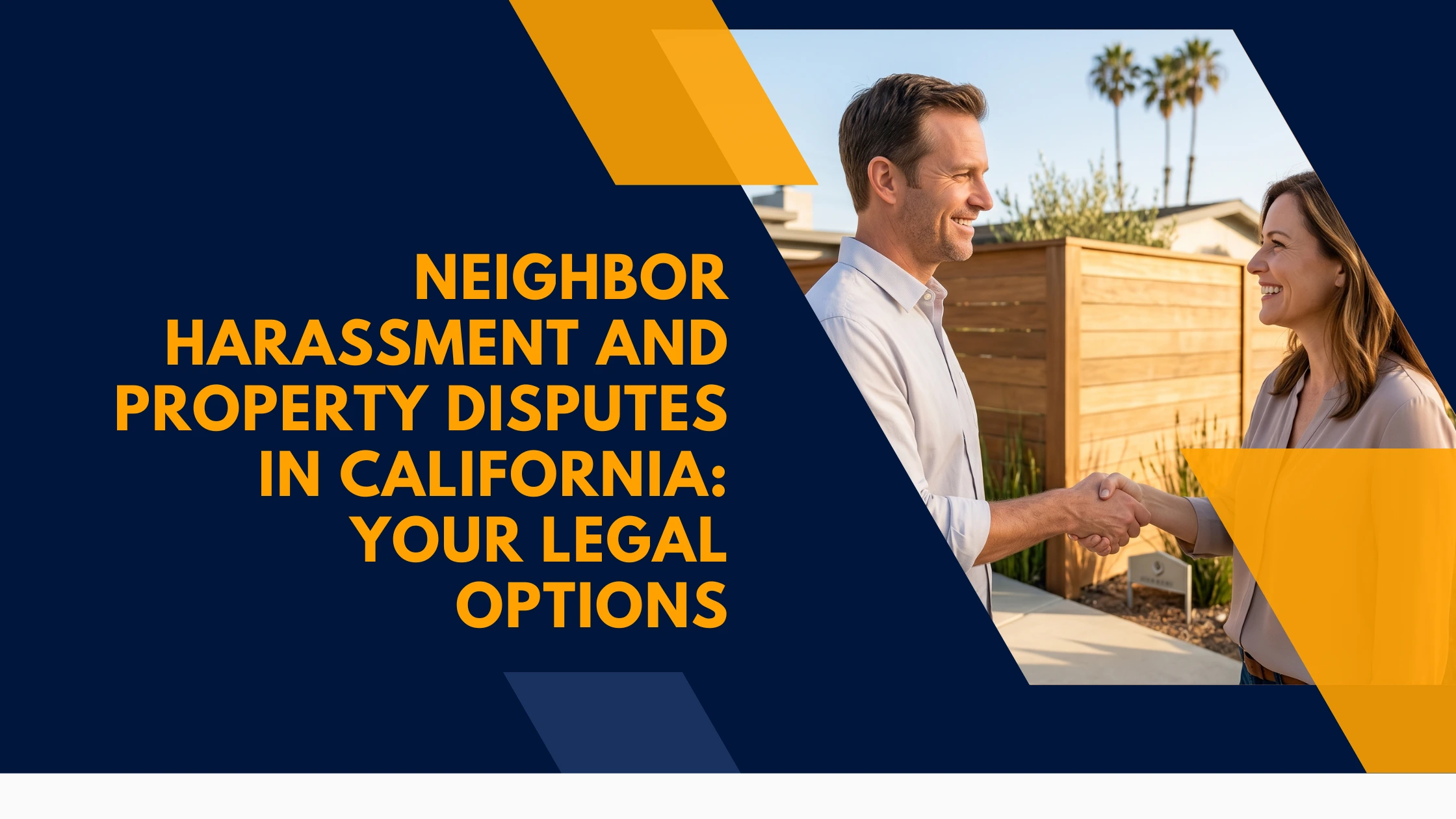
Bad neighbors can make a house feel like a prison
California has a lot of neighbor disputes. Property is expensive, lots are small, communities are dense, and people get attached to their homes. When a neighbor’s behavior crosses the line — into surveillance, encroachment, harassment, or worse — the right legal tools can make the difference between an ongoing nightmare and a resolved situation.
This article walks through what California law allows you to do when neighbor behavior becomes intolerable, from cease and desist letters to restraining orders to quiet title actions on the boundary itself.
Dealing with a neighbor situation that won’t resolve on its own?
Bay Legal, PC handles California neighbor and boundary disputes throughout the state. Call (650) 668-8000 or schedule a consultation at baylegal.com/contact.
The cease and desist letter: the right place to start
Most California neighbor disputes start with a cease and desist letter, sometimes called a demand letter. A well-drafted letter typically:
- Identifies the specific conduct (with dates, times, and witnesses where possible).
- States the legal basis — nuisance, harassment, encroachment, trespass.
- Demands that the conduct stop by a specific date.
- Preserves the right to pursue legal remedies if the conduct continues.
- Sometimes proposes a meeting or mediation to resolve the dispute without litigation.
A letter from an attorney often carries more weight than a letter from the property owner directly. It signals seriousness and creates a documented record — which matters substantially if the dispute escalates to court. Many California neighbor disputes resolve at the cease and desist stage, particularly when the neighbor has not previously been confronted with the legal exposure of their conduct.
Civil harassment restraining orders
California Code of Civil Procedure section 527.6 authorizes a civil harassment restraining order against a person who has engaged in:
- Unlawful violence.
- A credible threat of violence.
- A knowing and willful course of conduct directed at a specific person that seriously alarms, annoys, or harasses the person, and that serves no legitimate purpose.
The procedure typically involves:
- Filing a petition (Judicial Council form CH-100 and supporting declarations).
- Obtaining a temporary restraining order if the showing supports it (often ex parte at the start of the case).
- A hearing within approximately 21 days for the permanent order.
- A permanent order that can last up to five years and is renewable.
Civil harassment restraining orders can include stay-away provisions, no-contact provisions, prohibitions on third-party messaging, and (in some cases) firearm relinquishment. Violation of a restraining order is a criminal offense.
Document everything. California civil harassment restraining orders require evidence — text messages, photos, video, witness statements, police reports. The more contemporaneous documentation you have of the neighbor’s conduct, the stronger the petition. Start a log of incidents now, even if you are not yet sure whether you’ll seek an order.
Nuisance claims for ongoing problems
California Civil Code section 3479 defines a nuisance broadly: “Anything which is injurious to health, including, but not limited to, the illegal sale of controlled substances, or is indecent or offensive to the senses, or an obstruction to the free use of property, so as to interfere with the comfortable enjoyment of life or property, or unlawfully obstructs the free passage or use, in the customary manner, of any navigable lake, or river, bay, stream, canal, or basin, or any public park, square, street, or highway, is a nuisance.”
Civil Code section 3480 distinguishes public nuisance (affecting an entire community or neighborhood) from private nuisance (affecting a specific person or property). Private nuisance is the typical neighbor-dispute theory.
Common California private nuisance scenarios:
- Excessive noise — music, barking dogs, late-night construction, recurring parties.
- Odor — improper waste disposal, livestock, marijuana cultivation.
- Light — high-intensity outdoor lighting directed onto an adjoining property.
- Drainage and water issues.
- Vegetation issues — overhanging branches, invasive plants, root intrusion.
- Visual obstruction — fences or structures that interfere with reasonable use.
Nuisance plaintiffs typically seek injunctive relief (an order to stop or abate the nuisance) and damages for the harm caused. Code of Civil Procedure section 731 authorizes the abatement remedy.
Spite fences and trees as fences
California Civil Code section 841.4 codifies the spite fence rule:
“Any fence or other structure in the nature of a fence unnecessarily exceeding 10 feet in height maliciously erected or maintained for the purpose of annoying the owner or occupant of adjoining property is a private nuisance. Any owner or occupant of adjoining property injured either in his comfort or the enjoyment of his estate by such nuisance may enforce the remedies against its continuance prescribed in Title 3, Part 3, Division 4 of the Civil Code.”
The California Court of Appeal in Wilson v. Handley (2002) 97 Cal.App.4th 1301 extended the rule to rows of trees, holding that a planted row of trees can be a “structure in the nature of a fence” within section 841.4. The Vanderpol v. Starr (2011) 194 Cal.App.4th 385 decision applied similar reasoning to a Monterey cypress row.
Spite fence claims require proof of malice — that the fence (or tree row) was erected for the purpose of annoying the neighbor rather than serving a legitimate purpose. The malice element is the typical battleground in California spite-fence litigation.
Boundary and encroachment disputes
California recognizes several mechanisms for resolving boundary uncertainty and encroachment:
Survey-based resolution
A licensed land surveyor establishes the legal boundary based on the recorded subdivision map and county records. When survey results are clear and accepted, the boundary is settled.
The agreed-boundary doctrine
California courts can enforce an agreed boundary between neighbors when there is uncertainty about the true line, the parties agree on a boundary, and they have acquiesced in that boundary for a sufficient period. The doctrine is fact-specific.
Adverse possession
California Code of Civil Procedure sections 322 through 325 authorize adverse possession claims, which require:
- Actual possession of the disputed area.
- Possession that is open and notorious (visible and obvious).
- Possession that is hostile and adverse to the true owner’s rights.
- Possession that is continuous and uninterrupted for five years.
- Payment of all property taxes on the disputed area for the five-year period.
The property tax requirement under section 325 is often the decisive element — California requires the adverse possessor to have actually paid the taxes, which is harder than it sounds for typical small encroachments.
Encroachment removal
Where a neighbor’s fence, retaining wall, structure, or landscaping crosses the property line, the affected owner can seek removal through an injunction and damages action. The remedy depends on the encroachment’s nature and the equities.
Boundary line ambiguity making life difficult?
Bay Legal, PC resolves California boundary and encroachment disputes. Call (650) 668-8000 or schedule a consultation at baylegal.com/contact.
Surveillance and privacy
California has substantial law protecting against neighbor surveillance:
- Penal Code section 647(j) criminalizes “peeping” and surreptitious recording of areas where the victim has a reasonable expectation of privacy.
- Civil claims for invasion of privacy under California Constitution Article I, section 1.
- Common-law claims for intrusion upon seclusion.
- Statutory claims under Civil Code section 1708.8 for use of unmanned aerial vehicles (drones) to capture images or recordings.
Surveillance cameras that incidentally capture an adjoining property are generally permissible, but cameras targeted at a neighbor’s windows, backyard, or other private spaces can support invasion of privacy claims. The line is fact-specific — and California courts increasingly grapple with smart-home cameras, doorbell cameras, and drones.
Tree disputes
California tree disputes have their own complex framework:
- Civil Code section 833 — trees whose trunks stand wholly on one property belong to that owner.
- Civil Code section 834 — trees whose trunks straddle the property line are common property.
- Civil Code section 3346 — provides for treble damages (or double damages where the act was casual or involuntary) for wrongful injuries to trees.
- Code of Civil Procedure section 733 — provides for alternative treble damages for trespass to trees.
A neighbor who unilaterally cuts a boundary tree or causes substantial damage to a tree on the adjoining property can face significant statutory damages. The Metropolitan Water District v. Campus Crusade for Christ (2005) line of cases has produced complex doctrine on damages measurement — generally cost of restoration, but bounded by reasonableness.
When to escalate and when to mediate
Not every California neighbor dispute belongs in court. Consider the options:
- Direct conversation — sometimes the neighbor does not know their conduct is causing problems.
- Cease and desist letter — creates a record and often produces voluntary cooperation.
- Mediation through a neutral with neighbor-dispute experience.
- HOA enforcement (if applicable) — boards have authority to enforce CC&Rs against unit owners.
- Code enforcement complaint — for nuisances that violate municipal ordinances.
- Police report — for criminal conduct (peeping, trespass, vandalism, harassment).
- Civil harassment restraining order — for serious or escalating personal conduct.
- Civil lawsuit — for nuisance, trespass, encroachment, boundary disputes.
A California real estate attorney can help you choose the right level of escalation. Going too aggressive too fast can damage the long-term neighbor relationship without resolving the underlying issue; waiting too long can let evidence fade and conduct escalate.
Need a strategy that actually fits your situation?
Bay Legal, PC scopes California neighbor disputes and recommends the right next step. Call (650) 668-8000 or schedule a consultation at baylegal.com/contact.
Frequently Asked Questions
What legal actions can you take if a neighbor is surveilling or harassing you?
Depending on the specific conduct: a cease and desist letter, a civil harassment restraining order under Code of Civil Procedure section 527.6, civil claims for invasion of privacy or intrusion upon seclusion, and criminal complaints for peeping or unauthorized recording under Penal Code section 647(j). Document the conduct contemporaneously.
What is a cease and desist letter and when should you send one to a neighbor?
A cease and desist letter from an attorney identifies the offending conduct, the legal basis, and a demand to stop. It creates a record, often produces voluntary cooperation, and preserves rights for further legal action. It is typically the first step in California neighbor disputes once direct conversation has failed.
When can you obtain a restraining order against a neighbor in California?
Code of Civil Procedure section 527.6 authorizes a civil harassment restraining order against a person engaged in unlawful violence, credible threats of violence, or a knowing and willful course of conduct that seriously alarms, annoys, or harasses the petitioner. Documentation of the conduct is critical to obtaining the order.
What qualifies as an encroachment or boundary dispute in California?
An encroachment is when a structure, fence, or landscaping element extends across the property line onto a neighbor’s land. Boundary disputes can be resolved through surveys, the agreed-boundary doctrine, or adverse possession claims under Code of Civil Procedure sections 322 through 325.
How can a demand letter resolve a neighbor dispute without going to court?
A well-drafted demand letter often prompts the neighbor (or their attorney) to evaluate the legal exposure and decide that voluntary cooperation is cheaper than litigation. Many California neighbor disputes resolve at the demand letter stage. When they do not, the letter strengthens the record for the next step.
Disclaimer
This article is for general informational purposes only and does not constitute legal, tax, or financial advice. Reading this article and contacting Bay Legal, PC does not create an attorney-client relationship. The information here is specific to California law, which changes over time, and your situation may involve facts that change the analysis. If you have a real estate question that matters to you, speak with a licensed California attorney about your specific circumstances.