
Navigating California’s Rules of Professional Conduct for attorney advertising is essential for legal marketing compliance. The core principle, Rule 7.1, prohibits any false or misleading communication. Rule 7.2 governs law firm advertising, outlining permissible payments, while Rule 7.3 details strict limits on the direct solicitation of clients. Under Rule 7.4, lawyers cannot claim to be a “specialist” unless officially certified. Finally, Rule 7.5 ensures firm names are not misleading. Adhering to these standards prevents disciplinary action and maintains professional integrity.
A Guide to Attorney Advertising Rules: Navigating California’s Rules of Professional Conduct
Navigating Social Security Disability Insurance (SSDI) can be overwhelming. The first and most critical step is understanding your technical eligibility, which is based entirely on your work history. This guide breaks down the complex rules of social security work credits in a simple, scannable format.
Understanding how many work credits for SSDI you need and whether you pass the crucial recent work test can determine if your application moves forward or is denied before your medical condition is even considered.
Ready to discuss your legal needs? Contact Bay Legal, PC to explore how we may be able to assist you. You can call our office at (650) 668-8800, email our intake team at intake@baylegal.com, or schedule a consultation directly using our online booking calendar. We look forward to hearing from you.
What Are Social Security Work Credits?
Social Security work credits are the building blocks of your eligibility for SSDI benefits. Think of them as premiums you pay for an insurance policy.
- How You Earn Them: You earn credits when you work and pay FICA taxes, which are deducted from your payslip.
- Earnings Required: In 2025, you earn one credit for every $1,810 in wages or self-employment income.
- Annual Limit: You can earn a maximum of four credits per year. Once you earn $7,240 in a year, you have secured your four credits for that year.
The 2 Key Tests for Work Credits
To be eligible for SSDI, you must pass two different tests related to your work credits: the Duration of Work Test and the Recent Work Test.
The Duration of Work Test
This test looks at how long you have worked over your lifetime. The main question it answers is how many work credits for SSDI you need in total. While the general rule is 40 credits, the requirement changes based on your age when your disability began.
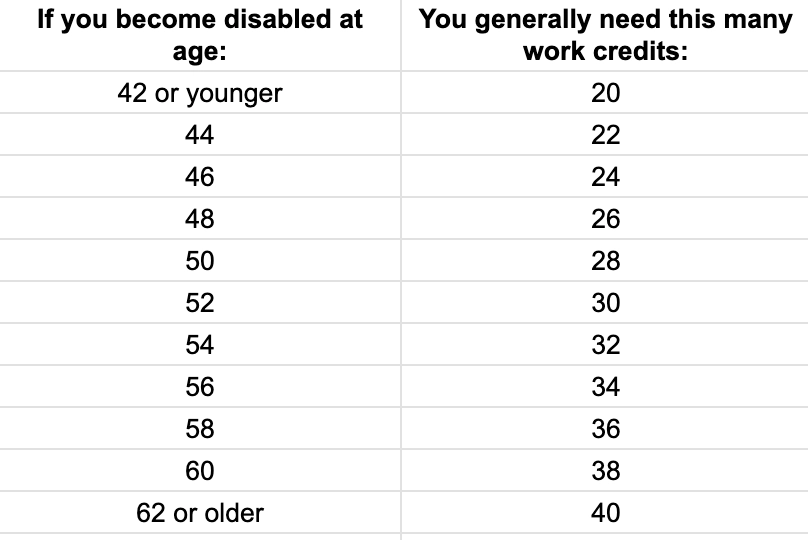
Younger Worker Rules:
- Before age 24: You may qualify with 6 credits earned in the 3 years before your disability started.
- Ages 24 to 31: You may qualify if you worked half the time between age 21 and when you became disabled.
The Recent Work Test
This test is often a trap for applicants. It is not enough to have enough credits; they must also be recent. The recent work test ensures your “insurance coverage” is up to date.
- The Rule: For most people, you must have earned 20 credits in the 10 years immediately before your disability began.
- What It Means: This means you must have worked for at least five of the last ten years.
- Common Pitfall: If you have a long work history but stopped working more than 10 years ago, you will likely fail the recent work test and be denied, even if you have more than 40 credits.
Navigating legal matters can be complex, but finding guidance for your next steps can provide clarity. If you are ready to discuss your situation, our team at Bay Legal, PC is available to help. To begin, please call us at (650) 668-8800 or send an email to intake@baylegal.com. For your convenience, you may also schedule an appointment directly through our booking calendar.
What Happens After You Pass the Work Tests?
Passing both the duration and recent work test means you have cleared the first major hurdle. The Social Security Administration (SSA) now considers you “technically eligible” and will proceed to the medical review of your claim.
This is where the process becomes much more intensive. The SSA uses a strict 5-Step Sequential Evaluation to determine if your medical condition meets their definition of disability.
- Are You Working? The SSA checks if your earnings exceed the Substantial Gainful Activity (SGA) limit ($1,620/month in 2025). If they do, your claim is denied.
- Is Your Condition Severe? Your impairment must significantly limit your ability to perform basic work activities for at least 12 months.
- Does Your Condition Meet a Listing? The SSA checks if your condition matches a specific impairment in their “Blue Book.” If it does, you may be approved.
- Can You Do Past Work? If not, the SSA assesses if you can perform any of the jobs you held in the last 15 years.
- Can You Do Any Other Work? Finally, the SSA considers if you can adjust to any other type of work that exists in the economy, given your age, education, and skills.
To learn more about how the law applies to your specific circumstances, we invite you to connect with our firm. Bay Legal, PC offers legal services tailored to the needs of our clients, and we are ready to discuss potential options for your matter. Contact us at (650) 668-8800 or intake@baylegal.com to start the conversation, or book a convenient time for your consultation using our online scheduling calendar.
Frequently Asked Questions (FAQs)
What is the first step in checking my disability eligibility in California?
The first step is to review your work history. The SSA requires you to have earned enough social security work credits to be insured before your medical condition is even considered.
How does the SSA define a “disability”?
The SSA defines disability as the inability to engage in any substantial gainful activity (SGA) due to an impairment that is expected to last for at least 12 months or result in death.
Are the SSA requirements the same in every state?
Yes, the rules for social security work credits are part of a federal program, so they are the same nationwide. Understanding local resources for disability eligibility in California can be helpful as you gather your documentation.
What role does my age play in SSDI eligibility?
Age is a significant factor, especially for those over 50. The SSA’s rules make it easier for older individuals to be found disabled, as they are considered less able to adjust to new work.
Can I work while applying for SSDI?
You can work, but your earnings must not exceed the SGA limit. Earning over this amount will almost always result in a denial.
What happens if my initial SSDI application is denied?
You have the right to appeal. The first step is Reconsideration, and if denied again, you can request a hearing. It is important to act quickly, as there are strict deadlines.
How long does my medical condition need to last to meet disability eligibility?
Your disabling condition must have lasted or be expected to last for a continuous period of at least 12 months. Short-term disabilities do not qualify.
Who is eligible for SSDI without a long work history?
Younger workers may be eligible with fewer work credits. How many work credits for SSDI you need depends on your age when you became disabled.
Why is the recent work test so important?
The recent work test is crucial because it proves your disability insurance is “active.” Many people with enough total credits are still denied because their work was not recent enough.
Do I need a lawyer to apply for SSDI?
While not required, professional guidance can be beneficial for navigating the complex SSA requirements. An attorney can help gather evidence and represent you at hearings.
If you are facing the daunting task of applying for SSDI and need help understanding your social security work credits or the recent work test, Bay Legal PC is ready to advise you. We work to clarify your technical eligibility and assist with your application. For inquiries or to start a conversation about your claim, please email us at intake@baylegal.com.
Attorney Advertising Disclaimer
This website and its contents are for informational purposes only and do not constitute legal advice. Prior results do not guarantee a similar outcome. Every estate planning matter is unique and depends on specific circumstances and applicable law. Viewing this site or contacting Bay Legal, PC does not create an attorney–client relationship. If you need legal advice, please schedule a consultation with a licensed attorney.