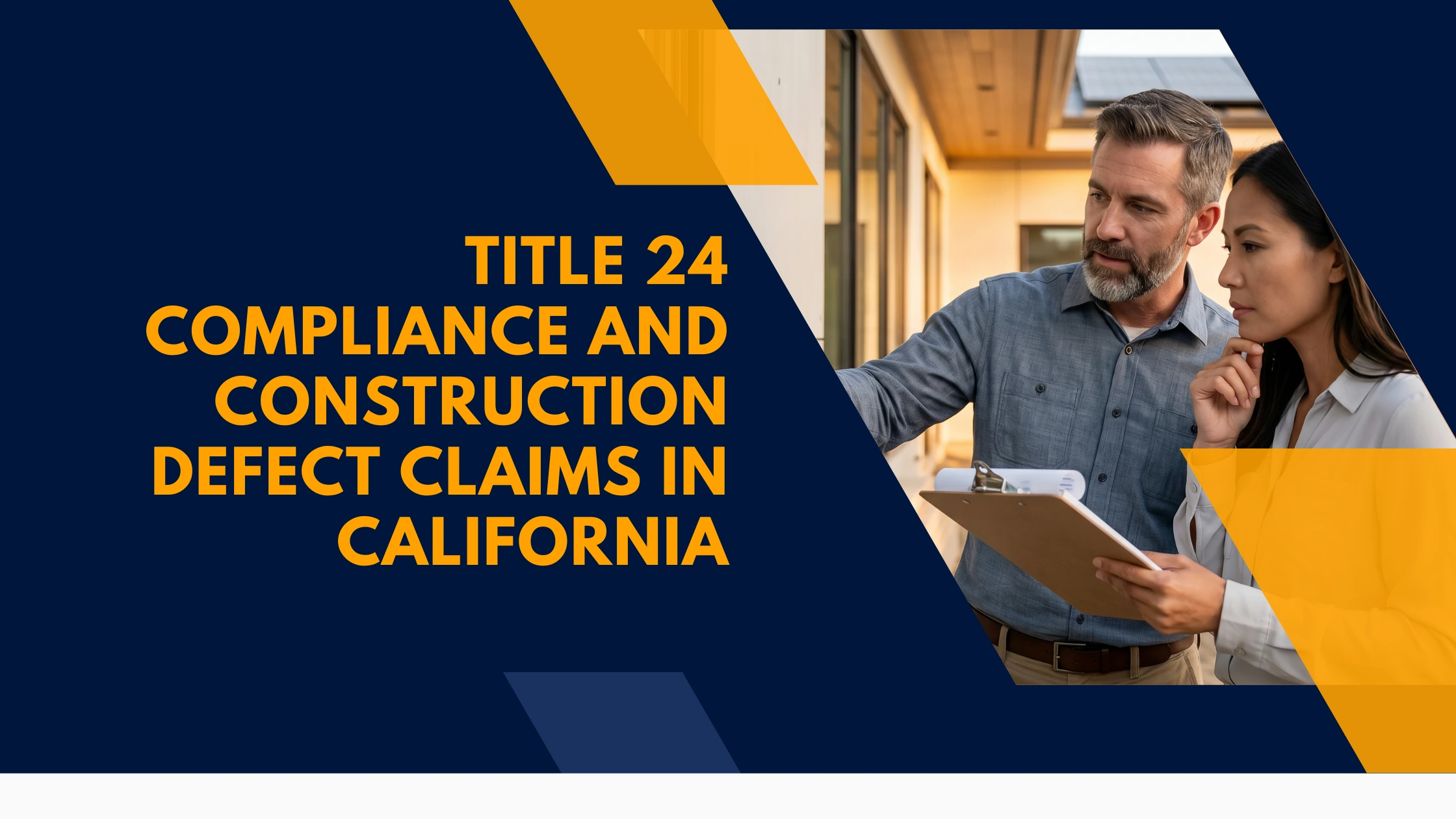
California’s 2025 Title 24 Building Standards Code update takes effect January 1, 2026, applying to all permit applications submitted on or after that date. Key changes include a new standalone Wildland-Urban Interface (WUI) Code, higher energy efficiency standards, expanded electrification requirements, stricter accessibility rules for renovations, and updated fire and life safety provisions. AB 130 freezes residential building code updates until at least 2031, making this the last update for several years. For property owners and contractors, these changes are legally significant: a violation of the California Building Standards Code can serve as evidence of negligence under the negligence per se doctrine and may form the basis of a construction defect claim.
What Is Title 24 and Why Does the 2025 Update Matter?
Title 24 is the California Building Standards Code — the comprehensive set of building standards that governs all construction in the state. It is published as Title 24 of the California Code of Regulations and consists of 12 parts covering everything from structural safety and energy efficiency to plumbing, electrical, fire protection, and accessibility.
California updates Title 24 on a triennial cycle. The 2025 edition was published on July 1, 2025, and takes effect January 1, 2026. It applies to all permit applications submitted on or after that date.
What makes this update especially significant is AB 130, a budget trailer bill that freezes residential building code updates until at least June 1, 2031. The 2025 code is the last Title 24 update for residential construction for several years — no 2028 residential code cycle will occur. Nonresidential standards continue on the normal three-year cycle. This means the standards adopted in the 2025 update will define residential construction requirements in California for the foreseeable future.
What Are the Major Changes in the 2025 Title 24 Update?
Part 7: The New California Wildland-Urban Interface (WUI) Code
One of the most consequential changes is the creation of a standalone California Wildland-Urban Interface Code, codified as Title 24, Part 7. Previously, wildfire-resistant construction standards were scattered across three different code sections:
- California Building Code (Part 2, Chapter 7A)
- California Residential Code (Part 2.5, Section R337)
- California Fire Code (Part 9, Chapter 49)
These provisions have now been consolidated, reorganized, and cross-referenced into a single enforceable code. For contractors working in designated WUI areas, Part 7 governs requirements for ignition-resistant construction, including exterior walls, roofing assemblies, vents, decks, eaves, fences, and other vulnerable building components.
The consolidation is expected to reduce ambiguity and increase consistency in enforcement. However, it may also result in stricter scrutiny of materials, listed products, and installation details during plan check and field inspection — creating new compliance obligations for builders.
Part 6: Higher Energy Performance Standards
The California Energy Code (Part 6) continues to move toward higher-performance, lower-carbon buildings. The 2025 update is notable for its encouragement of energy-efficient heat pumps for space and water heating, updated HVAC efficiency requirements, and strategies to shift energy use away from peak demand times. According to the California Energy Commission, the 2025 code will save Californians almost $5 billion in energy costs over 30 years.
For contractors, the practical impact is significant:
- Compliance now depends not only on design intent but also on field verification, commissioning, and documentation
- Home Energy Rating System (HERS) testing and system performance reports are increasingly required
- Greater coordination among framing, mechanical, and electrical trades is necessary
- New energy use “budgets” for buildings encourage (and in some cases effectively require) heat pump installations
- Increased efficiency requirements for exterior walls, windows, and insulation
Electrification: Expanded Electrical Scope and EV Infrastructure
Electrification policies embedded throughout Title 24 — in Parts 2, 2.5, 6, and 11 — are materially expanding the electrical scope of work on new construction and major renovations:
- Increased electrical service sizing and load calculation requirements
- EV-ready and EV-capable infrastructure requirements for residential and commercial buildings
- Increased percentage of parking spaces requiring Level 2 EV chargers (up from 10% to 25% for multifamily)
- Mandatory Automatic Load Management System (ALMS) measures as an option to reduce electrical capacity needs
- J1772 or J3400 connector specifications for EV charging stations
Part 10: Accessibility Upgrades for Renovation Projects
The California Existing Building Code (Part 10) has been amended to more closely align alteration and retrofit projects with Chapter 11B accessibility standards in the California Building Code (Part 2). Key changes include:
- Reduced references to older accessibility frameworks, increasing the likelihood that limited-scope tenant improvements or renovations will trigger additional accessibility upgrades
- Updated requirements for residential units with mobility features, including door signal devices, viewing devices, and front-loading appliances
- Increased clear floor space requirements at showers in adaptable units (from 30 inches to 36 inches)
- Alignment of reconstruction and alteration project thresholds with current accessibility standards
For property owners and contractors performing tenant improvements or building renovations, these changes mean that even relatively minor alterations may now trigger more extensive accessibility compliance requirements than under the previous code.
Fire and Life Safety: Clarified Requirements
The 2025 updates affect fire and life safety systems regulated under the California Building Code (Part 2), Mechanical Code (Part 4), and Fire Code (Part 9). Amendments clarify requirements for:
- Fire and smoke dampers in HVAC systems
- Essential electrical power for life-safety systems
- Integrated system performance in larger reconstruction or alteration projects
- Battery energy storage system regulations, including new provisions for consumer and commercial battery storage configurations
- Updated alarm, standpipe, and emergency communication requirements for healthcare and institutional occupancies
Part 11: Green Building Standards (CALGreen)
The California Green Building Standards Code (Part 11, known as CALGreen) continues to increase baseline expectations for construction practices. The 2025 update introduces:
- More rigorous documentation and on-site controls for construction waste management
- Enhanced water efficiency requirements
- Updated indoor air quality standards
- Previously voluntary bicycle parking requirements made mandatory for multifamily and hotel/motel projects
- CO2 monitoring requirements for university and private school classrooms
Is a Building Code Violation an Automatic Construction Defect?
This is one of the most important legal questions at the intersection of Title 24 compliance and construction litigation. The short answer: a code violation is not automatically a construction defect, but it is powerful evidence that can establish liability.
How Does the Negligence Per Se Doctrine Apply to Code Violations?
Under California’s negligence per se doctrine, codified in Evidence Code section 669, a violation of a statute, ordinance, or regulation creates a rebuttable presumption of negligence. To invoke this doctrine in a construction defect case, the plaintiff must establish four elements:
- The builder violated a statute, ordinance, or regulation (such as the California Building Standards Code)
- The violation proximately caused death or injury to person or property
- The death or injury resulted from an occurrence the statute was designed to prevent
- The person suffering the injury was within the class of persons the statute was intended to protect
If these elements are established, the burden shifts to the defendant to prove a justification or excuse for the statutory violation. Courts have applied negligence per se to building code violations, making a Title 24 violation a potent tool in construction defect litigation.
How Do Code Changes Create New Compliance Gaps?
Each Title 24 update raises the bar for construction quality and creates new potential grounds for defect claims. Here is how:
- A builder’s duty to comply with building codes is measured at the time of permit application — not at the time the contract was signed or construction began
- When new codes take effect, projects that have not yet obtained permits must meet the updated standards
- Practices that were compliant under the 2022 code may violate the 2025 code, creating liability for builders who fail to update their methods
- The AB 130 code freeze means the 2025 standards will remain in effect for residential construction for at least six years — a long period during which compliance gaps could accumulate
What Legal Claims Can Arise from Code Violations?
A violation of the California Building Standards Code may support multiple legal theories in a construction defect claim:
- Negligence per se: The code violation itself creates a presumption of negligence under Evidence Code section 669.
- Common law negligence: The builder failed to exercise the standard of care of a reasonable tradesperson.
- Breach of implied warranty: California imposes an implied warranty that construction work is performed in a reasonable, workmanlike manner according to current practices and government regulations.
- Statutory violations under SB 800 (Civil Code § 896): For new residential construction, SB 800 establishes specific building performance standards. Violations create statutory liability with defined remedies and timelines.
- Strict liability: In residential construction, builders may be strictly liable for construction defects that cause damage to other parts of the residence.
What Does This Mean for Homeowners?
If you are purchasing a newly constructed home in California with a permit application submitted on or after January 1, 2026, the 2025 Title 24 standards apply. This means:
- Your home should meet the latest energy efficiency, wildfire protection, accessibility, and safety standards
- If you discover defects that violate these standards, you may have a stronger legal basis for a claim than under previous code editions
- The AB 130 code freeze means the standards that applied when your home was permitted will remain the governing standards for years — providing a stable baseline for evaluating construction quality
For more information on construction defect claims, see our guide: What Qualifies as a Construction Defect in California?.
What Does This Mean for Contractors?
For builders and contractors, the 2025 Title 24 update creates both compliance obligations and liability exposure:
- Review the new WUI Code (Part 7) carefully if you work in wildfire-prone areas — the consolidation may reveal requirements you were not previously tracking
- Invest in training on the updated Energy Code (Part 6) requirements, particularly field verification, HERS testing, and commissioning procedures
- Understand that the expanded electrification requirements may require changes to your electrical subcontractor relationships and scope-of-work documents
- Monitor tenant improvement and renovation projects closely — the updated Part 10 accessibility triggers may expand the scope of required work
- Document compliance thoroughly — detailed records are your primary defense against future defect claims
For a comprehensive overview of all 2026 construction law changes, see our 2026 California construction law update.
What Does This Mean for HOAs?
Homeowners associations managing properties in Wildland-Urban Interface zones should pay particular attention to the new Part 7 WUI Code:
- The consolidated code may impose new or clarified maintenance obligations for common area landscaping, fencing, and building components in WUI zones
- HOAs should work with qualified professionals to assess whether existing common area construction meets the updated ignition-resistant standards
- Fire-hardening improvements to common areas may be advisable — and potentially required — under the new code
- When planning renovations or capital improvements, HOAs should budget for the increased compliance costs associated with the 2025 code
How Does Bay Legal Help with Title 24-Related Construction Defect Claims?
Bay Legal’s construction law team works with homeowners, contractors, and HOAs on construction defect matters involving building code compliance. Our approach includes:
- Evaluating whether specific construction defects involve violations of the California Building Standards Code
- Working with qualified experts to document code violations and their impact on property
- Advising contractors on compliance strategies to reduce liability exposure under the updated code
- Guiding homeowners and HOAs through the pre-litigation process under SB 800 for residential construction defects
- Representing clients in mediation, arbitration, and litigation involving construction defect claims
Need help with your construction project? Schedule a consultation with Bay Legal’s construction law team. Call (650) 668-8000 or visit baylegal.com/practice-areas/construction-law/.
Frequently Asked Questions About Title 24 and Construction Defects
Q: When does the 2025 Title 24 update take effect?
A: The 2025 edition of Title 24 takes effect January 1, 2026. It applies to all permit applications submitted on or after that date. Projects with permits issued before January 1, 2026, are generally governed by the previous (2022) edition.
Q: Does a building code violation automatically mean there is a construction defect?
A: Not automatically, but a code violation is strong evidence. Under California’s negligence per se doctrine (Evidence Code section 669), a violation of the Building Standards Code creates a rebuttable presumption of negligence. The plaintiff must still show the violation caused the injury or property damage.
Q: What is the AB 130 residential building code freeze?
A: AB 130 prevents California from adopting new residential building code updates until at least June 1, 2031, with limited exceptions for emergencies and wildfire mitigation. This means the 2025 Title 24 standards will govern residential construction for at least six years, with no 2028 residential code cycle.
Q: Does the new WUI Code apply to existing homes?
A: The new WUI Code (Part 7) primarily applies to new construction and major renovations requiring permits. However, some provisions relating to vegetation management and defensible space may affect existing properties in designated WUI zones. Homeowners and HOAs should consult with qualified professionals about their specific obligations.
Q: What is the statute of limitations for a construction defect claim in California?
A: Statutes of limitation for construction defect claims in California vary based on the type of claim. Negligence claims must generally be filed within four years of discovery for patent defects or within ten years of substantial completion for latent defects. All claims must be filed within three years of discovery. SB 800 provides specific timelines for residential construction ranging from one to ten years depending on the building component.
Disclaimer: This content is for informational purposes only and does not constitute legal advice. Results depend on the specific facts of each situation. No attorney-client relationship is created by reading this article. Contact Bay Legal, PC for advice on your specific situation.
Responsible Attorney: Bay Legal, PC — (650) 668-8000