TL;DR — Key Takeaways
- California law lets a city or county allow an ADU and the main house to be sold separately as condominiums. It does not require any city to allow it.
- As of mid-2026, roughly nine California cities had adopted enabling ordinances, plus unincorporated San Diego County. Los Angeles had not.
- Where it is allowed, the conversion requires a condominium plan, compliance with subdivision law, and a safety inspection before the plan is recorded.
- Every existing lienholder must consent before the condominium plan can be recorded. That requirement is the most common obstacle.
- Converting creates a homeowners’ association with ongoing legal obligations, even for a two-unit property.
- California’s first standalone ADU sale under the law closed in San Jose in 2026, nearly three years after it was enacted. That timeline says something about how hard these transactions are.
California allows an ADU to be sold separately from the main house only where the city or county has adopted an ordinance permitting it. AB 1033, enacted in 2023, authorizes local agencies to allow the primary dwelling and the ADU to be conveyed separately as condominiums, but it does not require any agency to do so. Where an ordinance exists, the owner must create a condominium plan, comply with subdivision and common interest development law, pass a safety inspection, and obtain the consent of every lienholder on the property.
Why this is opt-in
For most of California’s ADU history, state law allowed a local agency to prohibit selling an ADU separately from the main house, and nearly all did. AB 1033 changed that by authorizing, not mandating, separate conveyance.
The authorization now sits in the recodified ADU chapter of the Government Code. A local agency may adopt an ordinance allowing the primary dwelling and one or more ADUs to be conveyed separately as condominiums. If your city has not adopted one, the state law gives you no right to sell the ADU on its own.
A separate provision allows a narrower form of separate conveyance for certain qualified nonprofit affordable-housing arrangements. It applies to a specific category of projects and is not the route available to most homeowners.
Which cities have adopted it

This changes month to month, and published counts disagree depending on when they were compiled. As of a tracker dated July 2026, nine California cities had adopted enabling ordinances:
- San Jose (July 2024)
- West Hollywood (February 2025)
- Santa Cruz (February 2025)
- San Diego (July 2025)
- San Francisco (July 2025, limited to certain newer detached ADUs)
- Oakland (July 2025)
- Santa Monica (October 2025)
- Berkeley (January 2026)
- Sebastopol (February 2026)
Unincorporated San Diego County adopted an ordinance effective April 2026.
Los Angeles had not. As of July 2026, neither the City nor the County of Los Angeles had adopted an AB 1033 ordinance; a City Council motion to begin the process remained in committee.
Treat this as a dated snapshot. Confirm with your city’s planning department whether an ordinance is in effect and what it requires, since local ordinances can add conditions of their own.
If your city has adopted an ordinance and you are weighing a conversion, the lender question below is worth answering before anything else. Call Bay Legal at (650) 668-8000 in Northern California or (213) 668-8000 in Southern California.
What a conversion requires
Where an ordinance is in effect, state law sets baseline requirements, and the local ordinance may add more.
A condominium created under the Davis-Stirling Act. The primary dwelling and the ADU become separate condominium units, with the land and shared elements held as common area. That requires a condominium plan describing the units and the common area.
Subdivision Map Act compliance. The conversion is a subdivision and must comply with state and local subdivision rules, which typically means a map.
A safety inspection. Before the condominium plan is recorded, the ADU must have passed a safety inspection, shown by a certificate of occupancy or a qualifying housing-quality inspection report.
Lienholder consent. See below; it deserves its own section.
Existing association approval. If the property is already within a common interest development, the existing association must give written authorization before the plan is recorded.
Lienholder consent: the real obstacle
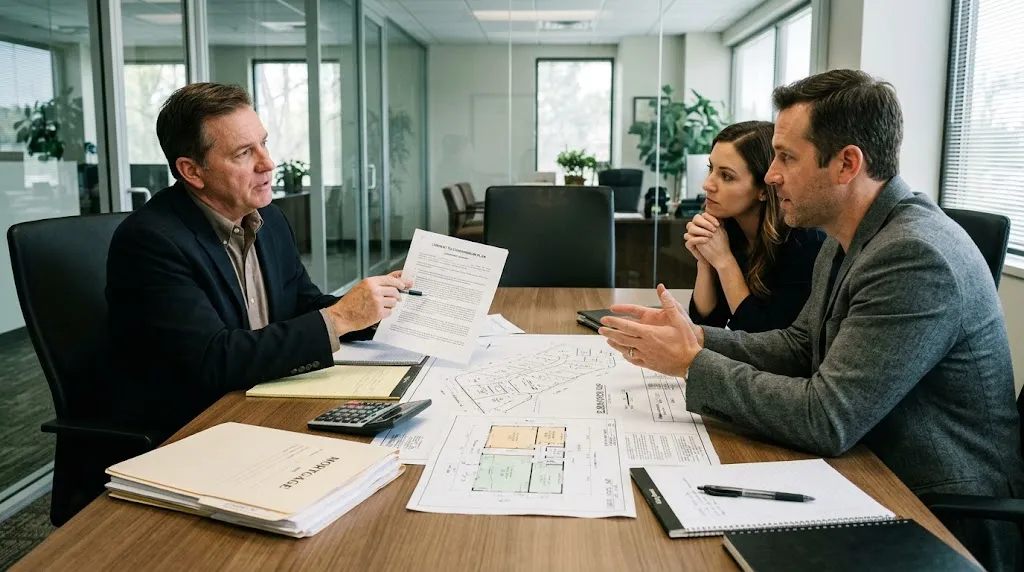
State law provides that neither a subdivision map nor a condominium plan may be recorded without the consent of each lienholder on the property. A lienholder may refuse, or may condition its consent, and written evidence of consent must be recorded with the plan.
That requirement explains most of the gap between the law’s enactment and actual sales. The existing mortgage on the property is secured by the whole lot. Converting to condominiums means splitting that security into two units, one of which the owner intends to sell. A lender that underwrote a loan against a single-family property has limited reason to agree, and many decline or impose conditions such as a paydown.
For an owner with a mortgage, the practical sequence is usually to talk to the lender first. An owner without a mortgage, or who can refinance into an arrangement the new lender will accept, faces a much shorter path.
Buyers, lenders, and title
The purchase side has its own difficulties, still developing in practice as of 2026.
Financing for buyers. Purchase-money financing for a standalone ADU condominium has been limited, because lenders have little experience with the product and few comparable sales to support appraisals.
Title insurance. Title insurers have approached these conversions cautiously while the product is new.
Appraisal. Without comparable sales, establishing value is harder, which affects both the buyer’s financing and the seller’s price.
These are market conditions rather than legal rules, and they may ease as transactions accumulate. The first standalone ADU sale under the law closed in San Jose in 2026, which suggests the path now exists and remains uncommon.
Tax and assessment consequences
A conversion and sale carry tax consequences that belong in the plan from the start, and they are questions for a tax professional.
Property tax. Selling either unit is a change in ownership of the unit sold, which is reassessed to current value. How the property’s existing assessed value is allocated between the two units after the conversion, and what the retained unit’s assessment becomes, are questions for the county assessor. Confirm them before the sale, not after.
Income tax. Selling the ADU is a sale of real property with its own gain calculation. Whether any part of the gain qualifies for the exclusion available on the sale of a principal residence, and how basis is allocated between the two units, depend on facts including how each unit was used. Those are questions for a CPA, and they can materially change the economics of the conversion.
Transfer tax. Documentary transfer tax, and in some cities an additional local transfer tax, applies to the sale.
The legal structure of the conversion is Bay Legal’s part of the work; the tax modeling is your CPA’s, and the two should talk before the condominium plan is recorded.
The HOA you create
A conversion creates a common interest development, which means an association with legal obligations under the Davis-Stirling Act, even where there are only two units and two owners.
The two owners will share responsibility for common elements such as the land, the roof or foundation depending on how the plan allocates them, utilities, and insurance. The association needs governing documents, a budget, and a way to make decisions. With two members, every decision is potentially a deadlock. The 50/50 LLC with no operating agreement addresses a closely analogous problem in a different setting, and the lesson carries over: the time to decide how disagreements will be resolved is before there is one.
When a separate sale is the wrong plan
Worth saying directly.
For many owners, the costs of a conversion, including survey, map, condominium plan, governing documents, lender negotiations, and the legal work that ties them together, will be substantial relative to the value unlocked, and the result is a permanent shared-ownership arrangement with a stranger in the back yard. Owners whose goal is income may do better renting the ADU. Owners whose goal is to help a family member may have simpler options in estate planning.
A separate sale tends to make sense where the owner has no lender or a cooperative one, the city’s ordinance is workable, the two units are genuinely separable, and the owner is comfortable with the shared-ownership relationship that follows.
Bay Legal advises owners on AB 1033 conversions and on the common interest development documents they require. Reach us at (650) 668-8000, (213) 668-8000, or through baylegal.com/contact-us.
Frequently Asked Questions
Does California allow ADUs to be sold separately from the main house?
Only where the city or county has adopted an ordinance allowing it. AB 1033 authorizes local agencies to allow the primary dwelling and ADU to be conveyed separately as condominiums, but does not require them to. Without a local ordinance, state law gives no right to sell the ADU on its own.
Which cities have adopted AB 1033?
As of a July 2026 tracker, nine cities: San Jose, West Hollywood, Santa Cruz, San Diego, San Francisco (limited to certain newer detached ADUs), Oakland, Santa Monica, Berkeley, and Sebastopol, plus unincorporated San Diego County effective April 2026. Los Angeles had not. The list changes frequently, so confirm with your city.
What is required to convert an ADU into a condominium unit?
A condominium plan under the Davis-Stirling Act, compliance with the Subdivision Map Act and local subdivision rules, a safety inspection before the plan is recorded, consent from every lienholder, and written authorization from any existing association the property belongs to. Local ordinances may add requirements.
What lender and title issues arise?
State law bars recording the map or condominium plan without each lienholder’s consent, and lenders may refuse or condition it, which is the most common obstacle. On the buyer side, purchase financing, title insurance, and appraisals have been harder to obtain because the product is new and comparable sales are few.
What HOA is created and what does it have to do?
The conversion creates a common interest development with an association governed by the Davis-Stirling Act, even with only two units. The owners share responsibility for common elements and need governing documents, a budget, insurance, and a way to resolve disagreements between two equal members.