TL;DR — Key Takeaways
- California condominium associations with buildings of three or more units must have their exterior elevated elements inspected under Civil Code section 5551.
- The first inspection was due by January 1, 2025, and every nine years after that. That deadline was not extended. The widely reported extension to 2026 applies only to apartment buildings under a different law.
- Only a licensed structural engineer, architect, or, since July 2024, civil engineer may perform the inspection. Contractors and building inspectors who can inspect apartments under the other law cannot inspect condominiums.
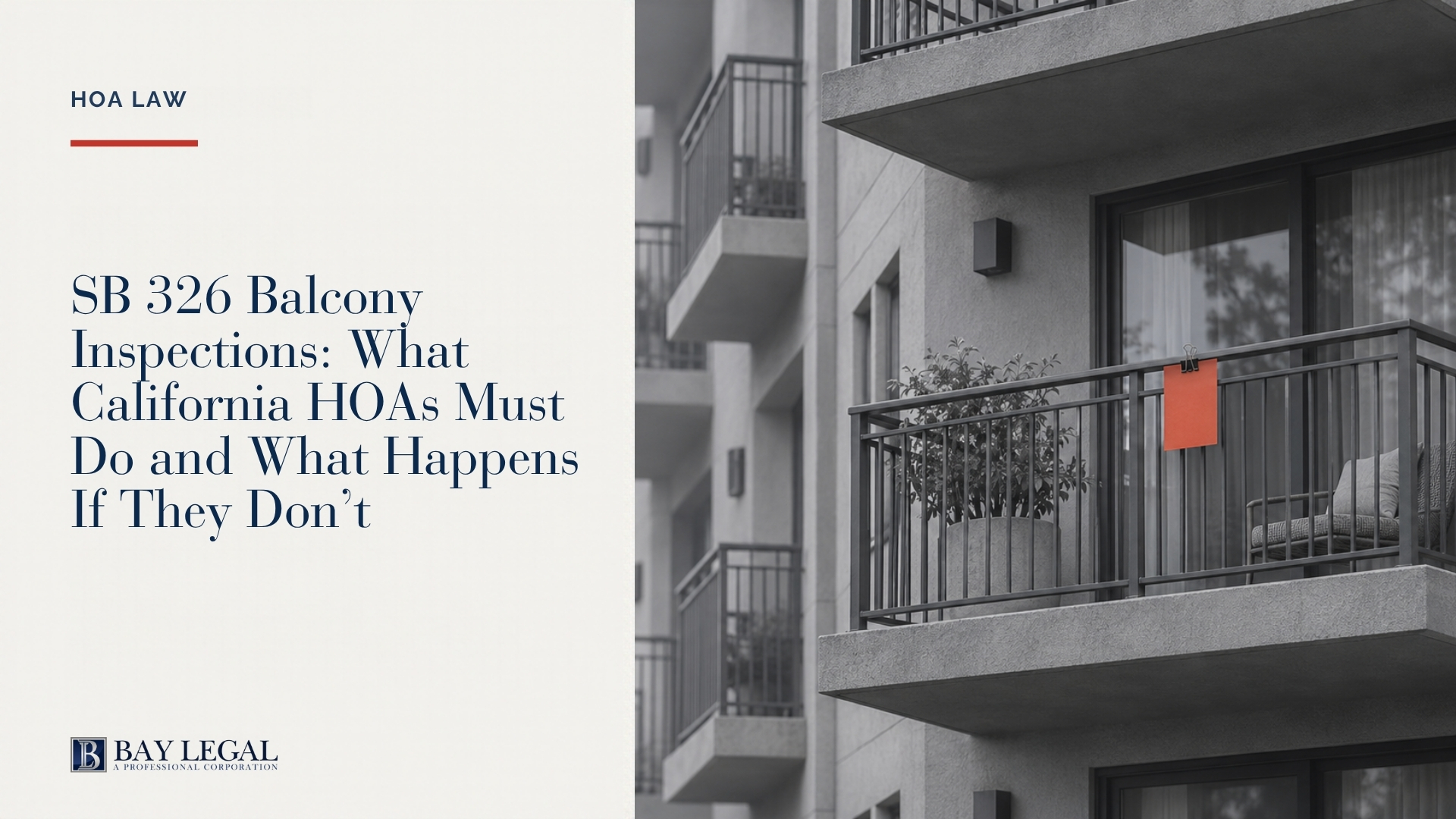
- The inspection covers balconies, decks, stairways, walkways, and landings more than six feet above grade whose load-bearing components are substantially supported by wood.
- Since January 1, 2026, the report is an association record and part of the resale disclosure package, so a missing or failed inspection is visible to buyers.
- An association that is out of compliance should get the inspection done now, not wait for a deadline that has already passed.
California condominium associations must have the exterior elevated elements of buildings with three or more multifamily units inspected by a licensed structural engineer, architect, or civil engineer. Under Civil Code section 5551, added by SB 326, the first inspection was due by January 1, 2025, with inspections every nine years after that. The condominium deadline was never extended. An association that has not completed its first inspection is out of compliance now.
This post covers what the law requires. If an inspection has already been done and the report identified problems, Bay Legal’s post on what HOAs must do after a failed SB 326 inspection covers the next steps.
The deadline that was not extended
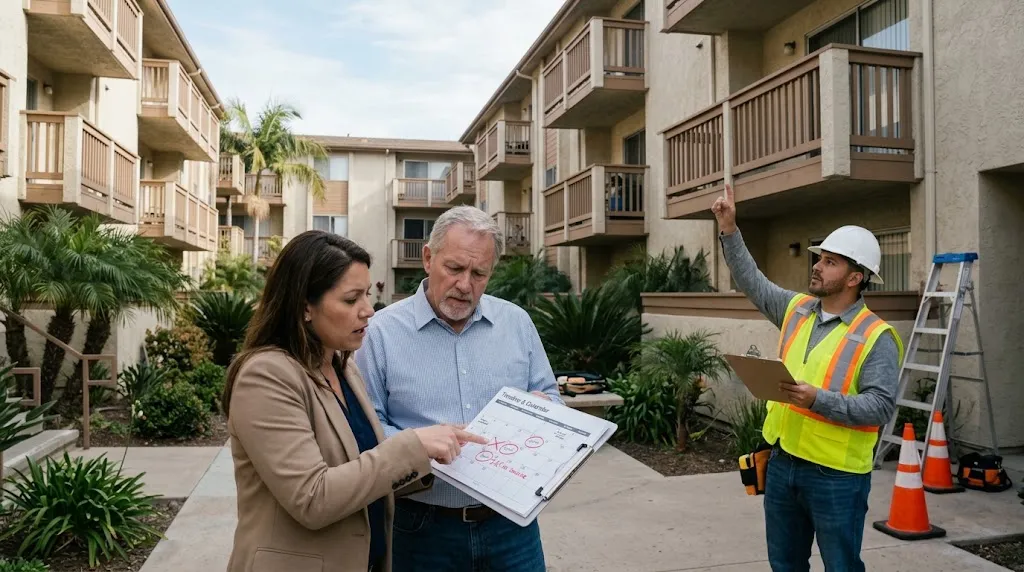
A significant amount of content, including some published by industry organizations, states that the SB 326 deadline moved to January 1, 2026. That is wrong for condominiums, and associations relying on it are exposed.
What happened is that two different laws govern balcony inspections in California, and one was extended while the other was not.
SB 326, codified at Civil Code section 5551, applies to common interest developments: condominiums governed by the Davis-Stirling Act. Its first inspection deadline was January 1, 2025, and no legislation has moved it.
SB 721, codified at Health and Safety Code section 17973, applies to apartment buildings. AB 2579 extended its first inspection deadline to January 1, 2026, and expressly did not extend the condominium deadline.
A 2024 bill, AB 2114, did amend section 5551, but only to add licensed civil engineers to the list of qualified inspectors. It did not change the deadline.
If your association has not completed its first inspection, the question is not whether there is still time. It is how quickly the inspection can be scheduled. Call Bay Legal at (650) 668-8000 in Northern California or (213) 668-8000 in Southern California.
What is covered
Which buildings. Buildings in a common interest development with three or more multifamily dwelling units.
Which elements. Exterior elevated elements, meaning balconies, decks, stairways, walkways, and landings, together with their railings, that are more than six feet above ground level, that the association is obligated to maintain or repair, and whose load-bearing components and associated waterproofing systems are supported substantially by wood or wood-based products.
What is not covered. Elements that are not substantially wood-supported, such as all-concrete or steel structures, fall outside section 5551, although they remain subject to the visual inspection required as part of the association’s reserve study. Elements an individual owner is responsible for maintaining under the CC&Rs are outside the association’s section 5551 obligation.
Who may inspect
Only three kinds of professionals:
- A licensed structural engineer.
- A licensed architect.
- A licensed civil engineer, added by AB 2114, which took effect July 15, 2024.
That list is narrower than the one for apartments. Under SB 721, certain licensed contractors with at least five years of experience and certified building inspectors may inspect apartment buildings. They may not perform SB 326 inspections for condominium associations. A report from an unqualified inspector does not satisfy section 5551, regardless of its quality.
How the inspection works
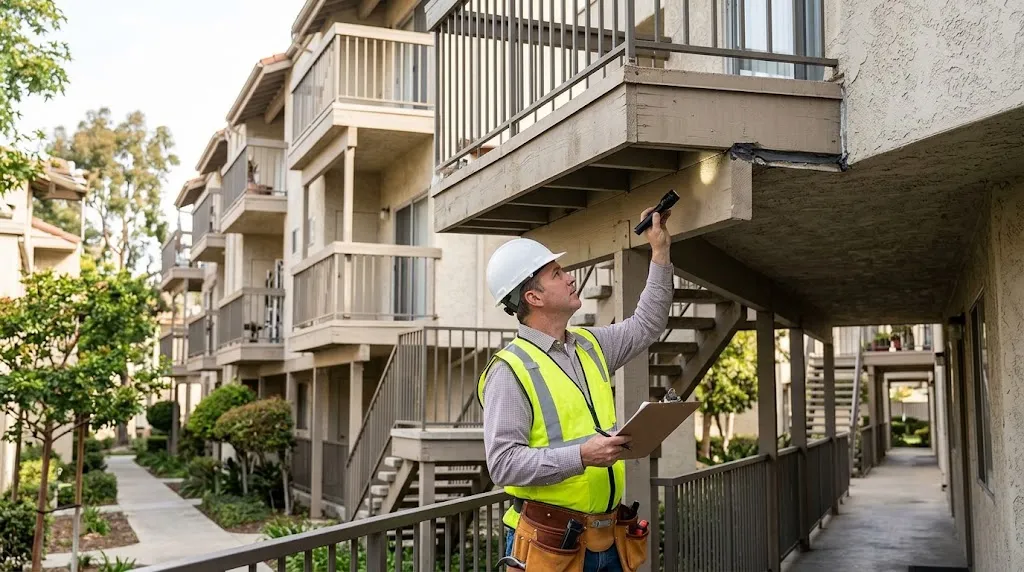
Sampling. The inspector visually inspects a random and statistically significant sample of the exterior elevated elements. Since January 1, 2026, section 5551 defines that sample as enough units to provide 95 percent confidence that the results reflect the whole, with a margin of error no greater than plus or minus 5 percent.
The report. The inspector’s written report must identify the load-bearing components and associated waterproofing systems, describe their current physical condition including whether any presents an immediate threat to occupants’ health and safety, assess their expected future performance and remaining useful life, and recommend any necessary repair or replacement. The report is stamped or signed by the inspector, presented to the board, and incorporated into the association’s reserve study.
Coordination with the reserve study. The nine-year cycle is designed to line up with the reserve study, which Civil Code section 5550 requires at least every three years. Findings from the balcony inspection feed directly into the association’s long-term funding plan. Reserve studies and special assessments covers that.
Record retention. Reports must be kept as association records for two inspection cycles.
Who pays for the inspection and the repairs
The inspection itself is the association’s obligation and is ordinarily paid from association funds as a common expense.
Repairs are a different question, and it frequently surprises owners. Many balconies and decks are exclusive use common area: they are part of the common area, but only the owner of the unit they attach to may use them. California’s default allocation, which the CC&Rs can change, generally makes the association responsible for repairing and replacing common area and the owner responsible for day-to-day maintenance of exclusive use common area appurtenant to their unit. The CC&Rs, and in particular their maintenance matrix if they have one, determine how that works in a given project.
That allocation can produce disputes when an inspection report recommends significant work. An owner may argue the repair is the association’s responsibility as structural replacement; the association may argue that deferred owner maintenance caused the damage. The answer depends on the governing documents and on what caused the deterioration, which is one reason the inspector’s findings about cause matter.
Where repairs trace to original construction rather than to maintenance, the cost may be recoverable from the developer, subject to the deadlines that run from substantial completion.
Immediate threats
If the inspector finds that an element poses an immediate threat to the safety of occupants, the inspector must give the report to the association immediately and to the local code enforcement agency within 15 days. The association must then take preventive measures immediately, including preventing occupant access to the element until repairs have been inspected and approved by the local enforcement agency.
That is a mandatory response, not a board discretion question. Closing a balcony that owners use daily is unpopular; leaving one open after an immediate-threat finding is indefensible.
What happens if an association does not comply
Section 5551 does not impose a daily fine of the kind the apartment law imposes on building owners. That has led some boards to treat the requirement as optional. It is not.
Resale disclosure. Since January 1, 2026, the latest inspection report is an association record that owners may request and part of the documents provided to prospective buyers. A buyer’s lender or agent who sees that no inspection was done, or that a report identified unaddressed problems, will ask questions, and those questions can complicate sales throughout the building.
Liability. If an uninspected element fails and someone is injured, the association’s failure to comply with a mandatory inspection statute will be central to the claim. Directors who knew of the requirement and did not act have a difficult duty-of-care position. HOA board fiduciary duty covers the standard directors are held to.
Insurance. Insurers and lenders increasingly ask about SB 326 compliance, and a lapse can affect coverage and financing.
When the report is bad news
Worth saying plainly, since it is the reason some boards delay.
An inspection may identify expensive repairs, and those may require a special assessment or a loan. Boards sometimes put off the inspection because they fear the answer. That gets the risk backwards. The deteriorating element exists whether or not it is inspected, and the cost of repair typically rises the longer water intrusion continues. Delay trades a known, plannable expense for an unknown liability and a larger repair bill.
And where the repairs trace to original construction, the report may be the first evidence of a construction defect claim against the developer, which carries its own deadlines. HOA developer transition covers the clock that runs from substantial completion.
Bay Legal advises associations on SB 326 compliance and on the repair, funding, and defect questions that follow. Reach us at (650) 668-8000, (213) 668-8000, or through baylegal.com/contact-us.
Frequently Asked Questions
What does SB 326 require and which buildings are covered?
SB 326, codified at Civil Code section 5551, requires condominium associations to have exterior elevated elements inspected in buildings with three or more multifamily dwelling units. Covered elements are balconies, decks, stairways, walkways, and landings more than six feet above grade, maintained by the association, whose load-bearing components are substantially supported by wood.
What is the inspection deadline and re-inspection cycle?
The first inspection was due by January 1, 2025, and inspections are required every nine years after that. The condominium deadline was not extended; the extension to January 1, 2026 applies only to apartment buildings under SB 721, as amended by AB 2579.
Who is qualified to perform the inspection?
A licensed structural engineer, a licensed architect, or, since AB 2114 took effect on July 15, 2024, a licensed civil engineer. Licensed contractors and certified building inspectors, who can inspect apartment buildings under SB 721, cannot perform SB 326 inspections for condominium associations.
What must the board do with an adverse finding?
If the inspector identifies an immediate threat to occupant safety, the association must take preventive measures immediately, including preventing access to the element until repairs are inspected and approved by the local enforcement agency. Other findings feed into the reserve study and repair planning. The report must be kept for two inspection cycles.
What liability follows a missed inspection?
Section 5551 has no daily penalty like the apartment law, but noncompliance carries real consequences. The report has been part of the resale disclosure package since January 1, 2026, so a missing inspection is visible to buyers and lenders, and if an uninspected element fails and causes injury, the failure to comply will be central to any claim against the association.
Disclaimer: This article is for general informational purposes only and is not legal, tax, or financial advice. Reading it or contacting Bay Legal, PC does not create an attorney-client relationship. It addresses California law only; other states differ. The law changes, and figures and procedures described here may be updated after this article’s publication date.