TL;DR — Key Takeaways
- The gun trust california pitch that works in other states mostly does not apply here. Elsewhere these trusts are sold for holding National Firearms Act items. In California, Penal Code section 33410 makes possessing a silencer a felony, and section 32625 makes possessing or knowingly transporting a machinegun an offense except as that chapter authorizes.
- Inheritance is already an exception to the dealer requirement, trust or no trust. Penal Code section 27545 normally requires a private transfer to go through a licensed dealer. Section 27920 disapplies that for “a person who takes title or possession of a firearm by operation of law” – if the person is not prohibited and the conditions are met.
- A trustee is more regulated here than an executor, not less. Both must file a report with the Department of Justice within 30 days. But a trustee of an ordinary living trust falls in the group that must also obtain a valid firearm safety certificate before taking title or possession. An executor does not.
- A registered assault weapon cannot simply be inherited and kept, and no trust changes that. Section 30915 gives a person who obtains title “by bequest or intestate succession” 90 days to do one of four things: render it permanently inoperable, sell it to a licensed dealer, obtain a Department of Justice permit, or remove it from the state.
- The executor’s real exposure is federal and it does not require certainty. 18 U.S.C. 922(d) makes it unlawful “to sell or otherwise dispose of any firearm” to someone “knowing or having reasonable cause to believe” they are prohibited. Distribution from an estate is disposing of it, and in a family reasonable cause is usually present.
The Direct Answer
Firearms can pass by will or trust in California, but the recipient must not be prohibited, and taking possession triggers its own requirements: a report to the Department of Justice within 30 days, a firearm safety certificate in some cases, and for a registered assault weapon a 90-day deadline with no option to keep it.
Gun Trust California: What a Trust Does and Does Not Change
Less than the marketing suggests, and the California reason is specific.
In most states, a “gun trust” is a National Firearms Act planning tool. Its selling point is holding items whose transfer is slow and paperwork-heavy – suppressors, short-barrelled rifles, machineguns – so that more than one person can lawfully possess them and so that they pass without a fresh federal transfer at death.
That rationale largely collapses at the California border. Penal Code section 33410: “Any person, firm, or corporation who within this state possesses a silencer is guilty of a felony.” Penal Code section 32625(a): a person who “possesses or knowingly transports a machinegun, except as authorized by this chapter, is guilty of a public offense.” The two categories that drive gun trusts elsewhere are a felony or tightly permit-controlled here.
So a California trust has to be justified on succession grounds instead, and on those grounds it does two real things:
- It avoids probate for the collection, the same way it does for everything else in the trust, which matters where a collection is valuable and where public inventory is unwelcome.
- It names a trustee in advance, which matters because the alternative is that firearms sit in the control of whoever happens to be administering the estate.
What it does not do is exempt anyone from the transfer rules. Nothing in the sections below turns on whether the firearm is held in a trust, and one of them – the firearm safety certificate requirement – actually applies more strictly to a trustee than to an executor.
This article covers California law and the one federal prohibition that most often catches families. It does not address the National Firearms Act, federal registration or transfer procedure, or any agency’s forms or practice, none of which was researched for it.
Can Firearms Pass Through a California Will or Trust?
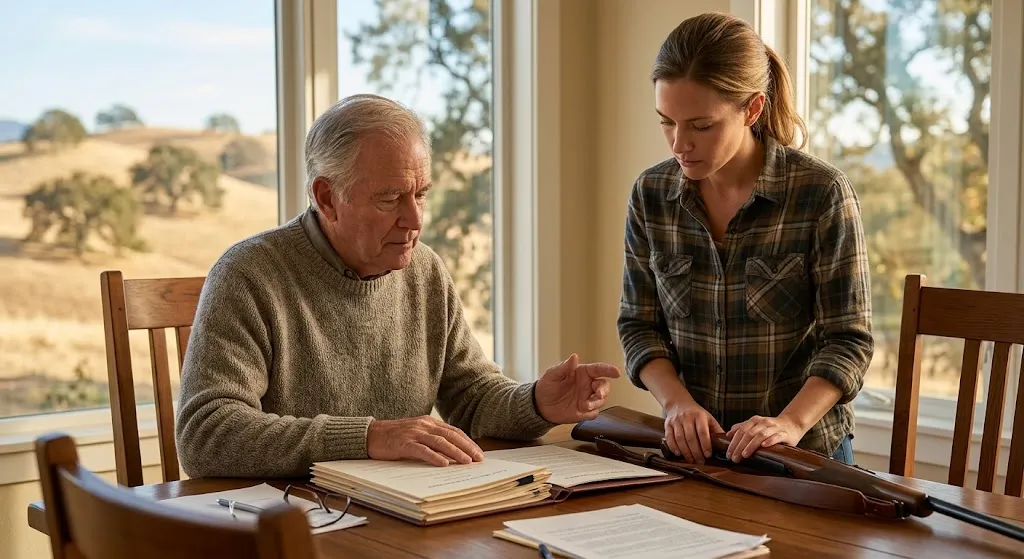
Yes. The can you leave guns in a will california question has a straightforward answer, and the complications are all on the receiving end.
A firearm is personal property and it passes like other personal property – by will, by trust, or by intestate succession. What changes is that the moment of receipt is regulated.
Start with the default rule the exception carves out of. Penal Code section 27545: where neither party holds a dealer’s license, the parties “shall complete the sale, loan, or transfer of that firearm through a licensed firearms dealer.” That is California’s universal dealer requirement for private transfers.
Then section 27920 disapplies it for inheritance, because inheritance is a transfer by operation of law: section 27545 does not apply to someone taking title or possession “by operation of law” if that person is not prohibited from possessing a firearm and the listed conditions are met.
Penal Code section 16990 then defines who counts as taking title or possession by operation of law, and the list is long and specific. The ones that matter in an estate:
| Who | Section 16990 |
|---|---|
| The executor, personal representative or administrator of an estate, if the estate includes a firearm | (a) |
| A firearm passing to a surviving spouse under the Probate Code’s spousal property procedure | (h) |
| A firearm passing to a decedent’s successor under the small-estate procedure | (l) |
| The trustee of a trust that includes a firearm and that was part of a will that created the trust | (k) |
| The trustee of a trust that includes a firearm and is under court supervision | (p) |
| The trustee of a trust that is not referenced in subdivisions (k) or (p) – the ordinary living trust | (q) |
| A person acting under a power of attorney | (m) |
| A conservator, guardian, guardian ad litem or special administrator | (n), (s), (o), (r) |
The list also covers secured creditors, levying officers, receivers, bankruptcy trustees, assignees, a police officer’s family receiving a firearm from a local agency, and a finder receiving one from a law enforcement agency.
The threshold condition is the one to read twice. The exception applies only “if the person is not prohibited.” Everything else is procedure; that is substance.
What Transfer Requirements Apply to Inherited Firearms in California?
A report, a deadline, and – for some recipients but not others – a certificate first.
The 30-day report. Under section 27920(a)(1), a person taking title or possession by operation of law must, within 30 days of taking possession, report to the Department of Justice who took the firearm, how and from whom title or possession passed, and a description of the firearm. Levying officers and certain other recipients are outside that paragraph.
The certificate, and the distinction almost nobody draws. Section 27920(a)(2) applies to a person receiving under section 16990(g), (h), (l) or (q). Those recipients must file the same 30-day report and, “prior to taking title or possession of the firearm, the person shall obtain a valid firearm safety certificate.”
Read that against the section 16990 list:
- An executor takes possession under subdivision (a), which is not in section 27920(a)(2)’s list. Report within 30 days; no certificate requirement under that paragraph.
- A trustee of an ordinary living trust takes possession under subdivision (q), which is in that list. Report within 30 days, and obtain a valid firearm safety certificate before taking title or possession.
- A surviving spouse under (h) and a small-estate successor under (l) are also in that list.
So the firearm transfer after death california sequence is more demanding for the trust route than for the probate route – which is the opposite of what a family expects when someone sells them a trust as the simpler path. The statute also contains a separate rule for handguns within that certificate requirement; this article does not state it, because the clause was not read in full.
What this article does not tell you. It states no form number, no fee, no filing address and no Department of Justice procedure, because none of that was researched. The department prescribes the manner of the report, and that is where to get it.
The 90-Day Assault Weapon Rule, and Why No Trust Changes It

This is the provision that most often turns an ordinary estate into a problem, and it has no workaround.
Penal Code section 30915 sets a ninety-day clock: someone who takes title to a registered assault weapon by bequest or intestate succession must, within 90 days, render it permanently inoperable, sell it to a licensed dealer, obtain a Department of Justice permit, or remove it from the state.
Four options, and none of them is “keep it.”
Three things follow that matter for planning rather than for crisis management:
- The clock runs from obtaining title, not from discovering the problem. Ninety days is not long when an estate is still locating documents.
- Nothing in section 30915 turns on how the person obtained title. It applies to a bequest or to intestate succession alike, and a trust is not an exception to it.
- This is a question to answer while the owner is alive, because the owner knows what is registered and the family usually does not. A list is worth more here than a document.
The permit route in option (c) points to a separate article of the Penal Code that was not read for this article, so nothing is said here about who can obtain such a permit or on what terms. The same applies to section 30630, which section 30915 names.
How Should an Estate Handle a Prohibited-Person Beneficiary?
Carefully, early, and on the assumption that the personal representative is the one at risk.
The federal prohibition is the one to plan around, and its standard is lower than people expect. 18 U.S.C. 922(d): it is unlawful to sell or otherwise dispose of a firearm or ammunition to a person “knowing or having reasonable cause to believe” that person falls in a prohibited class falls into one of the listed categories – including a person under indictment for or convicted of a crime punishable by more than a year’s imprisonment, a fugitive, an unlawful user of or person addicted to a controlled substance, a person adjudicated as a mental defective or committed to a mental institution at 16 or older, certain non-citizens, a dishonourable discharge, a person who renounced citizenship, and a person subject to a qualifying restraining order.
“Otherwise dispose of” reaches a distribution from an estate or a trust. And the standard is not actual knowledge – it is reasonable cause to believe. Within a family, the executor usually knows about the felony conviction, the restraining order or the substance problem. That knowledge is exactly what section 922(d) makes into exposure.
California’s side of it is broad in a different way. Penal Code section 29800(a)(1) makes it a felony for a person convicted of a felony, or of certain enumerated offenses, or who is addicted to a narcotic drug, to own, purchase, receive, “or [have] in possession or under custody or control any firearm.” Custody or control, not just ownership – so handing over a key, or leaving the safe accessible, is the problem, not only signing something.
What an estate should actually do:
- Ask the question before anything moves. Whether a beneficiary is prohibited is a question of fact the family often already knows the answer to.
- Do not take possession casually. The executor’s own possession is authorized by section 16990(a) and section 27920, but it is authorized on conditions, and the 30-day report is one of them.
- Do not deliver to a prohibited beneficiary and do not let them hold the key. The value can still reach them; the firearm cannot.
- Sell through a licensed dealer where the answer is unclear. That is what section 27545 contemplates for an ordinary transfer, and it converts a compliance problem into a cash distribution.
- Get the assault weapon question answered first, because it has a 90-day clock and four options while the rest of the estate has none.
This article does not describe how to store, transport or surrender a firearm, and those questions were not researched for it.
When to Bring Counsel In
While the owner is alive, and before an executor or trustee takes possession of anything.
The while-alive case is the one that actually works. The owner knows what is in the collection, what is registered, and which family members can lawfully receive what. Nobody else will reconstruct that, and section 30915’s ninety days is not enough time to find out. A written inventory left with the plan is worth more than the trust document.
The before-possession case matters because the exception that makes inheritance workable – section 27920 – is conditional. It applies only if the recipient is not prohibited, and it carries a 30-day reporting duty and, for a trustee of an ordinary living trust, a certificate requirement that has to be satisfied before taking possession. A trustee who takes the safe home first and asks afterwards has already done the thing the statute sequences the other way.
And the honest answer on the trust itself: in California a trust is worth having for a firearms collection for the same reasons it is worth having for anything else – probate avoidance, privacy, a named successor – and not for the National Firearms Act reasons that sell these products in other states. Anyone selling a California gun trust on suppressor or machinegun grounds should be asked to reconcile that with sections 33410 and 32625.
Related reading includes what an executor in California does, a successor trustee’s first ten steps after a death, how digital assets and RUFADAA work for executor access, a trustee’s guide to a complete inventory of trust assets, and when you need a probate attorney.
Work with Bay Legal
Bay Legal, PC advises California families and fiduciaries on firearms in an estate, including transfer requirements after a death, assault weapon deadlines, and distributions where a beneficiary may be prohibited. If you are planning a collection’s succession or administering an estate that includes firearms, call (650) 668-8000 in Northern California or (213) 668-8000 in Southern California, or schedule a consultation at https://baylegal.com/contact-us/.
Frequently Asked Questions
Can firearms pass through a California will or trust?
Yes. A firearm is personal property and passes by will, trust or intestate succession. Penal Code section 27545 normally requires a private transfer to go through a licensed dealer, but section 27920 disapplies that for a person who takes title or possession by operation of law – which section 16990 defines to include an executor, personal representative or administrator, a surviving spouse under the spousal property procedure, a small-estate successor, and the trustee of a trust. The exception applies only if the recipient is not prohibited from possessing a firearm.
What transfer requirements apply to inherited firearms in California?
A report to the Department of Justice within 30 days of taking possession, containing information about the person taking possession, how title or possession was obtained and from whom, and a description of the firearm. For recipients falling under section 16990(g), (h), (l) or (q) – which includes a surviving spouse, a small-estate successor and the trustee of an ordinary living trust – section 27920(a)(2) additionally requires a valid firearm safety certificate obtained before taking title or possession. An executor under subdivision (a) is not in that group.
What is a gun trust and when is it worth having?
In most states it is a National Firearms Act tool. In California that rationale largely does not apply, because section 33410 makes possessing a silencer a felony and section 32625 makes possessing or knowingly transporting a machinegun an offense except as authorized. A California trust is worth having for a collection for the ordinary reasons – avoiding probate, privacy, and naming a successor in advance. It does not exempt anyone from the transfer rules, and a trustee faces a certificate requirement an executor does not.
What are the risks for an executor who takes possession of firearms?
Two. The first is procedural: the section 27920 exception is conditional, so possession without the 30-day report is possession outside the exception. The second is substantive and federal: 18 U.S.C. 922(d) makes it unlawful to sell or otherwise dispose of a firearm to a person “knowing or having reasonable cause to believe” they are prohibited, and distribution from an estate is disposing of it. Reasonable cause, not certainty, is the standard – and in a family it is usually present.
How should an estate handle a prohibited-person beneficiary?
Establish the fact before anything moves, because families usually know. Do not deliver the firearm and do not allow access to it: Penal Code section 29800(a)(1) reaches a prohibited person who has a firearm “in possession or under custody or control,” so a key is enough. Where the answer is unclear, selling through a licensed dealer converts the problem into a cash distribution the beneficiary can receive. And resolve any registered assault weapon separately, because section 30915 gives 90 days and four options, none of which is keeping it.