
TL;DR — Key Takeaways
- There is no statute called the good faith exam. The good faith exam california med spa requirement is industry shorthand for Business and Professions Code section 2242, which makes it unprofessional conduct to prescribe, dispense or furnish dangerous drugs “without an appropriate prior examination and a medical indication.”
- The statute says the opposite of what most compliance content says about format. Since AB 1264 took effect on October 11, 2019, section 2242(a) has read: an appropriate prior examination “does not require a synchronous interaction” and can be achieved through telehealth, including a self-screening tool or a questionnaire.
- The proviso is the whole case. That sentence ends “provided that the licensee complies with the appropriate standard of care.” The Legislature relaxed the modality and left the standard of care untouched. The format question is settled; the adequacy question is not, and adequacy is where discipline actually happens.
- Who may perform it is answered by each licensee’s own practice act, not by section 2242. A nurse practitioner furnishing under section 2836.1 must be operating under an approved standardized procedure. A physician assistant must be operating under a practice agreement under section 3502.3. A registered nurse acts on an order or under standardized procedures, and section 2726 confirms the Nursing Practice Act “confers no authority to practice medicine or surgery.”
- If the examination is delivered by telehealth, a second statute applies and is frequently missed. Section 2290.5(b) requires the provider to inform the patient and obtain consent before delivery, and “The consent shall be documented.” Failure is independently unprofessional conduct under section 2290.5(d).
The Direct Answer
California has no statute using the phrase “good faith exam.” The requirement comes from Business and Professions Code section 2242, which conditions prescribing, dispensing or furnishing dangerous drugs on an appropriate prior examination and a medical indication. The statute expressly permits telehealth and asynchronous formats, subject to the applicable standard of care.
Where the Good Faith Exam California Med Spa Requirement Comes From
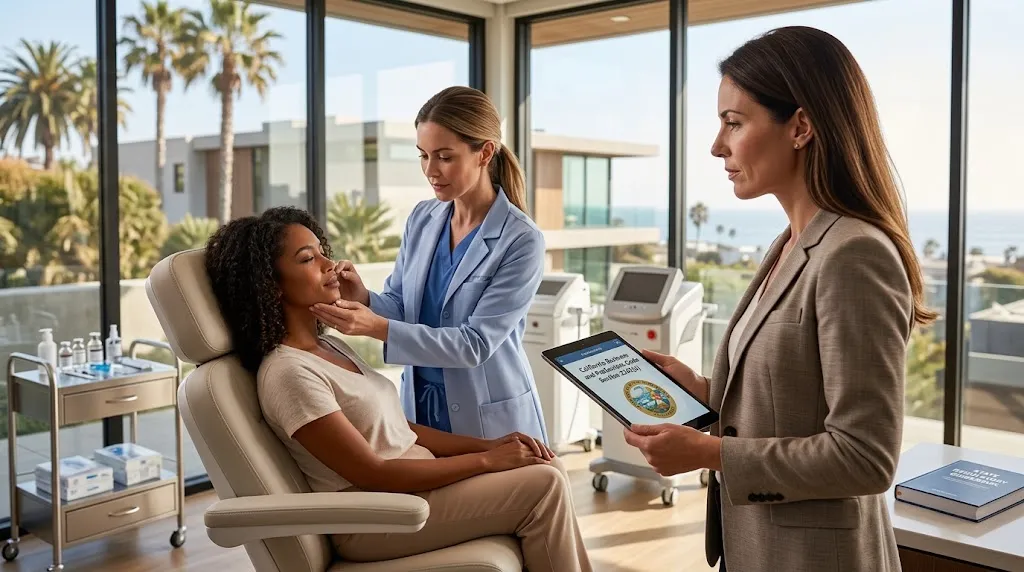
Every med spa compliance california checklist has a line for the good faith exam. Very few say where the obligation lives, and the answer changes how you satisfy it.
The source is Business and Professions Code section 2242(a): “Prescribing, dispensing, or furnishing dangerous drugs as defined in Section 4022 without an appropriate prior examination and a medical indication, constitutes unprofessional conduct.”
Three things follow from reading it rather than paraphrasing it.
It is a licensing rule, not a criminal one. Section 2242 creates unprofessional conduct, which is a discipline exposure for the licensee. It is not section 2052, which is the criminal exposure for unlicensed practice. The two often appear in the same investigation and they are not the same thing.
It attaches to the drug, not to the treatment room. The trigger is prescribing, dispensing or furnishing a dangerous drug as defined in section 4022. A business offering services that do not involve such a drug is not answering this question at all, and a business that does involve one cannot avoid it by calling the encounter a consultation.
It requires two things, and almost every summary drops the second. An appropriate prior examination, and a medical indication. A flawless examination that produces no medical indication for the product does not satisfy the section. This is the part that matters when a practice sells a package before anyone has examined anybody.
Section 2242(b) then lists four narrow circumstances in which no unprofessional conduct is found – a designated practitioner covering for the patient’s own for no more than 72 hours, an order transmitted to a nurse in an inpatient facility on stated conditions, a designated practitioner with the patient’s records renewing a medically indicated prescription, and action under Health and Safety Code section 120582. None of them describes a med spa.
Who Can Perform a Good Faith Exam in California?
Section 2242 does not say. It describes conduct by a licensee and leaves the question of which licensee to each practice act, which is why this question produces so much confused advice.
The correct method is to work from the licensee outward.
| Licensee | Authority to examine and order | Condition that is usually missing |
|---|---|---|
| Physician and surgeon | Bus. & Prof. Code 2051 | None; the certificate is the authority |
| Nurse practitioner, furnishing | 2836.1 | An approved standardized procedure, and no physician may supervise more than four NPs at one time |
| Nurse practitioner, independent | 2837.103; 2837.104 | The statutory qualifications, and a board certificate for practice outside the six listed settings |
| Physician assistant | 3502; 3502.1; 3502.3 | A signed practice agreement addressing all five statutory subjects |
| Registered nurse | 2725(b)(2); 2725(c) | A physician’s order, or a standardized procedure meeting all eleven contents of 16 CCR 1474 |
| Medical assistant | 2069 | An MA cannot perform this examination; section 2069 authorizes technical supportive services, not assessment |
Two points on that table deserve emphasis.
First, the paperwork in the right-hand column is paperwork no agency approves. Section 2725(d) says nothing requires approval of standardized procedures by either board. Section 3502.3(a)(5) says nothing requires board approval of a practice agreement. The absence of a gatekeeper is exactly why so many of these documents are defective – nothing catches the defect until an investigation does.
Second, the nurse practitioner row changed on January 1, 2023 and many med spa medical director requirements california templates still describe the old arrangement. Section 2837.103.5(b) provides that the article “shall not be construed to require a nurse practitioner practicing pursuant to Sections 2837.103 or 2837.104 to practice under standardized procedures or physician supervision.” A practice relying on a physician supervision structure for an NP who now practices independently is documenting a relationship the statute no longer requires – and a practice assuming every NP qualifies has made the opposite mistake.
Section 2726 is the limiting principle for the whole column: “Except as otherwise provided herein, this chapter confers no authority to practice medicine or surgery.”
Can a Good Faith Exam Be Done by Telehealth?
Yes, and the statute says so in terms. This is the single most commonly misstated point in California aesthetics compliance.
Section 2242(a), second sentence: an appropriate prior examination “does not require a synchronous interaction between the patient and the licensee” and can be met through telehealth, including a self-screening tool or questionnaire, so long as the licensee meets the standard of care.
That language has been in the section since AB 1264 took effect on October 11, 2019. Content asserting that the examination must be a live, real-time encounter is describing a rule the Legislature expressly declined to impose.
The proviso is not a formality. “Provided that the licensee complies with the appropriate standard of care” is what converts a permissive modality rule into a demanding substantive one. A questionnaire that no licensee meaningfully reviews satisfies the statute’s format and fails its condition. The correct reading is that the format question is settled and the adequacy question is open – and adequacy is the question a board actually asks.
There is a second statute, and skipping it is a free finding for an investigator. Section 2290.5 governs telehealth for the whole division. Subdivision (b): before delivering care by telehealth the provider initiating it must inform the patient and “obtain verbal or written consent” to that mode of delivery. The consent must be documented. Subdivision (d) makes failure to comply unprofessional conduct in its own right.
Subdivision (e) is the sentence to quote whenever someone argues that telehealth enlarges what a given licensee may do: the section “does not alter the scope of practice of a health care provider” or authorize delivery of services in a setting, or in a manner, not otherwise permitted by law. Telehealth changes the channel. It does not change the scope. Anyone building a telehealth good faith exam california workflow should read those two subdivisions together with section 2242 rather than in place of it.
How Often Must the Exam Be Repeated for Returning Patients?
Here is the honest answer, and it is more useful than a confident one.
No statute or regulation read for this article specifies an interval. Section 2242 conditions prescribing, dispensing or furnishing on an appropriate prior examination and a medical indication. It does not say the examination is good for ninety days, or a year, or a course of treatment. Neither does section 2290.5. Any specific interval a practice has been given came from somewhere other than the statute – a board publication, a malpractice carrier, a consultant, or a competitor’s policy.
What the statute does supply is the right question. The obligation attaches to each act of prescribing, dispensing or furnishing, and it requires an appropriate prior examination and a medical indication for that act. So the practical test is not calendar-based at all. It is whether, at the moment this product is furnished to this patient, there is a current examination that supports a current medical indication.
That reframing usually answers the real cases:
- A returning patient receiving the same treatment on the same clinical picture is a different case from one who has developed a new condition, started a new medication, or become pregnant.
- A patient moving from one product or treatment area to another is being furnished something the prior examination may not have addressed.
- A long gap since the last encounter is relevant because the clinical picture may have changed, not because a clock expired.
Building the policy this way has a second advantage. A practice that documents why the examination remains current for this act can defend that reasoning. A practice that documents only “within twelve months per policy” has adopted a standard no statute imposed and must still answer the statutory question.
What Happens When the Exam Is Skipped or Improperly Delegated?
The consequences separate cleanly, and they do not all land on the same person.
Unprofessional conduct for the prescribing licensee. This is section 2242’s own remedy, and it reaches the physician, nurse practitioner or physician assistant whose authority the product was furnished under.
Unprofessional conduct for the telehealth consent failure, separately. Section 2290.5(d). Note that subdivision (d) also provides “Section 2314 shall not apply to this section,” so do not assume the misdemeanour provision that covers the enforcement article extends here.
Unprofessional conduct for the physician who lent a name. Section 2264 makes it unprofessional conduct to employ, aid or abet any unlicensed person, or a suspended or revoked practitioner, “to engage in the practice of medicine” or any other mode of treating the sick that requires a license. A medical director who approves standardized procedures and then has nothing to do with the practice is describing section 2264’s facts.
Criminal exposure if the delegation went past the delegate’s scope. If the person who performed the assessment had no authority to perform it, the analysis moves to section 2052 – a public offense punishable by a fine not exceeding $10,000, county jail up to a year, or imprisonment under Penal Code section 1170(h) – and section 2052(b) applies the same punishment to anyone who conspires with, aids or abets.
And a structural exposure that survives all of the above. Section 2400 provides that “Corporations and other artificial legal entities shall have no professional rights, privileges, or powers.” A practice can fix every examination problem in this article and still be arranged in a way that no examination policy repairs.
When to Bring Counsel In
Before the protocol is written, and immediately on any inquiry that mentions a patient by name.
The before-drafting moment matters because the documents that make the arrangement lawful have to predate the treatment. A standardized procedure written after an inquiry is not evidence that the procedure governed the encounter. The same is true of a practice agreement and of a telehealth consent.
The inquiry moment is urgent because the exposures run in parallel and diverge. The prescribing licensee, the medical director and the business are each answering a different question, and an answer that helps one can damage another. That should be sorted before anyone replies.
There is also a reason to re-read a protocol that has been in the binder a while. Section 2242’s telehealth sentence has been law since October 2019 and the nurse practitioner scheme changed on January 1, 2023. A policy that requires a synchronous visit because “the law requires it” is imposing a burden the statute does not, and a policy assuming every nurse practitioner needs physician supervision may be describing a relationship that no longer exists.
Related reading includes telehealth business structure in California, telehealth business formation in California, remediating a non-compliant med spa in California, how to legally open a med spa in California, fee-splitting and kickbacks in California healthcare, how fair market value applies to medical director compensation, whether a non-physician can own a med spa in California, and California’s corporate practice of medicine doctrine.
Work with Bay Legal
Bay Legal, PC advises California med spas, aesthetic practices and telehealth businesses on examination and prescribing protocols, standardized procedures and practice agreements, medical director arrangements, and compliant entity structure. Call(650) 668-8000 in Northern California or (213) 668-8000 in Southern California, or schedule a consultation at https://baylegal.com/contact-us/.
Frequently Asked Questions
What is a good faith exam and why is it legally required?
It is industry shorthand. The legal requirement is Business and Professions Code section 2242, which makes it unprofessional conduct to prescribe, dispense or furnish dangerous drugs as defined in section 4022 “without an appropriate prior examination and a medical indication.” Two elements, not one: the examination and the indication. It is a licensing rule attaching to the licensee whose authority the product is furnished under, not a criminal statute and not a rule about the room.
Who can perform a good faith exam in California?
Section 2242 does not say, so the answer comes from each practice act. A physician may, on the strength of section 2051. A nurse practitioner may when furnishing under section 2836.1 with an approved standardized procedure, or independently under sections 2837.103 and 2837.104. A physician assistant may under a practice agreement meeting section 3502.3. A registered nurse acts on an order or standardized procedures. A medical assistant cannot; section 2069 authorizes technical supportive services, not assessment.
Can a good faith exam be done by telehealth?
Yes, and the statute says so. Section 2242(a) provides that an appropriate prior examination “does not require a synchronous interaction between the patient and the licensee” and can be achieved through telehealth, including a self-screening tool or questionnaire, provided the licensee meets the standard of care. That has been the law since October 11, 2019. Section 2290.5(b) separately requires documented patient consent to telehealth.
How often must the exam be repeated for returning patients?
No statute or regulation reviewed for this article sets an interval, and any specific number a practice has been given came from somewhere other than the statute. The obligation attaches to each act of prescribing, dispensing or furnishing and requires a current examination supporting a current medical indication for that act. A new condition, a new medication, a new product or a new treatment area matters more than the calendar.
What are the consequences of skipping or improperly delegating it?
Unprofessional conduct under section 2242 for the prescribing licensee; separate unprofessional conduct under section 2290.5(d) if telehealth consent was not obtained and documented; unprofessional conduct under section 2264 for a physician who aids an unlicensed person to practice medicine; and, if the person who assessed the patient had no authority to, criminal exposure under section 2052, which carries the same punishment for anyone who conspires with, aids or abets.