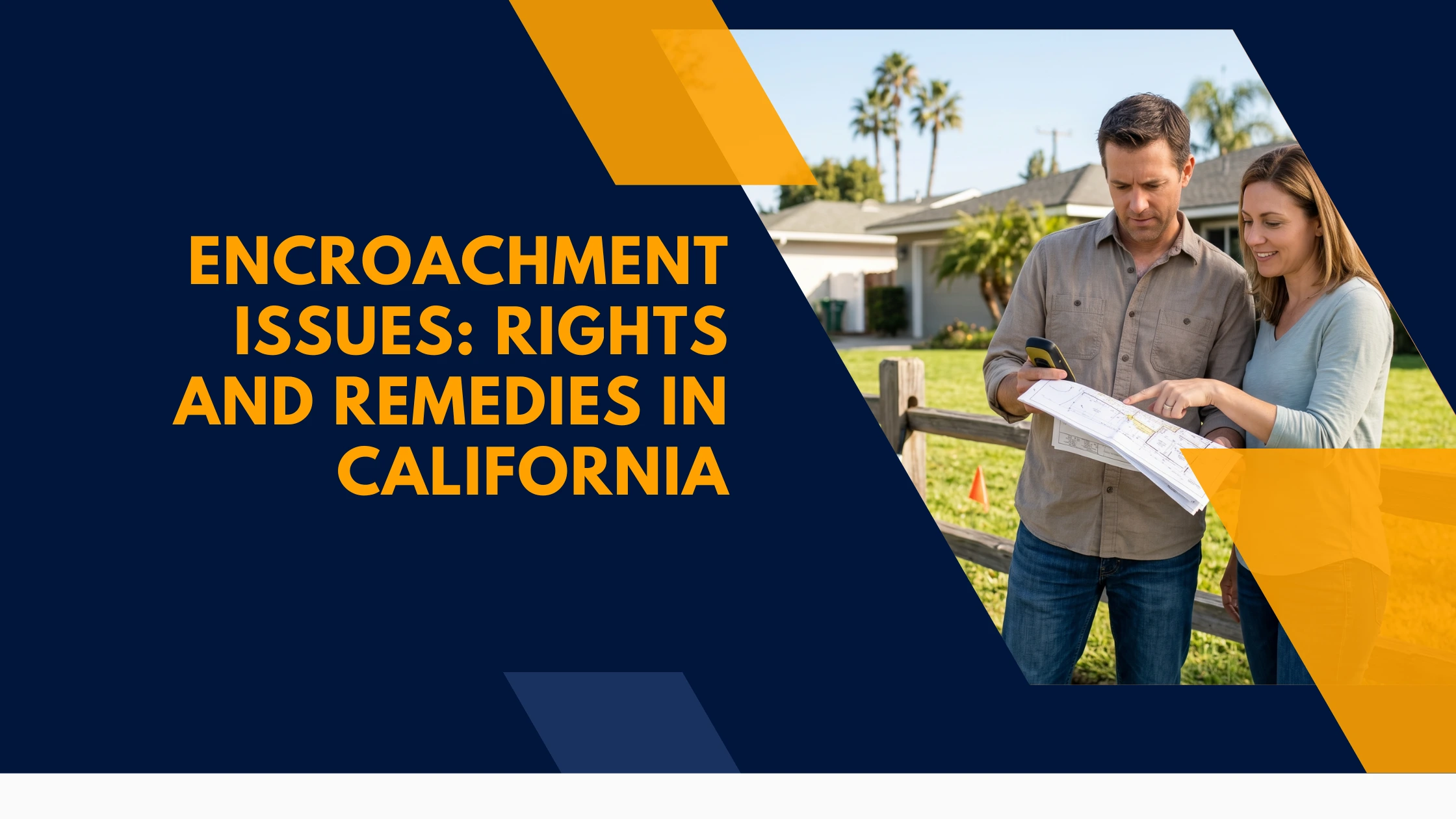
An encroachment in California is when a structure, fence, tree, or other improvement extends onto a neighboring property without permission. If someone else’s structure is on your land — or yours is on theirs — you may have the right to seek removal, monetary compensation, or a court order stopping further intrusion. The right approach depends on the type of encroachment, how long it has existed, and the relationship between the parties.
What Counts as an Encroachment Under California Law?
An encroachment occurs when any physical element of one property extends across the legal boundary line onto an adjacent parcel. Common examples include:
- Fences built a few feet over the property line
- Structures (garages, sheds, additions) whose footings or walls extend onto neighboring land
- Eaves and overhangs that project over a boundary at the roofline
- Tree trunks that grow across the property line (as opposed to branches that overhang)
- Tree roots that grow under the boundary and cause damage to structures, driveways, or utilities on the neighboring parcel
- Driveways and walkways that were poured or paved onto the wrong parcel
- Retaining walls built partly on neighboring property
The distinction between an encroachment and a trespass is important. Trespass typically refers to a person entering another’s land without permission. Encroachment is a continuing physical intrusion by a structure or natural feature. Both are actionable in California, but the remedies and statutes of limitations can differ.
What Is the Difference Between Encroachment and Trespass in California?
While trespass and encroachment both involve unauthorized use of someone else’s land, California courts treat them differently:
| Factor | Trespass | Encroachment |
|---|---|---|
| Nature | Person or personal property on land | Permanent or semi-permanent structure |
| Duration | Can be momentary or continuous | Usually continuous |
| Primary remedy | Damages for intrusion period | Injunction for removal + damages |
| Good-faith improver defense | Generally not applicable | Potentially applicable |
| Statute of limitations | 3 years (CCP §338) — property damage | Varies by theory |
A fence that has been over the property line for 20 years is an encroachment. Your neighbor tossing their garbage onto your land is a trespass. For structures, the line between the two concepts blurs — a temporary shed placed on your property is both.
What Remedies Are Available for Encroachment in California?
California courts have several tools to address encroachments, and the appropriate remedy depends on the circumstances.
Mandatory Injunction (Forced Removal)
The most straightforward remedy for an encroachment is a court order requiring the encroaching structure to be removed or moved back within the legal boundary. California courts will generally grant a mandatory injunction if:
- The encroachment is ongoing
- The plaintiff (the landowner whose property is encroached upon) has not unreasonably delayed in bringing the action
- The encroaching party had notice of the boundary
However, courts apply a balancing of hardships test: if removing the encroachment would cost the encroaching party vastly more than the harm the encroachment causes the neighbor, the court may deny forced removal and instead award money damages. This is especially common when a large structure sits partially on the wrong side of the line.
Money Damages
Where forced removal is denied or where the landowner prefers compensation to removal, California courts can award:
- Mesne profits — the rental value of the portion of your land occupied by the encroachment during the period of intrusion
- Diminution in value — the reduction in market value of your property caused by the encroachment
- Cost of removal — in some cases, the court may order the encroaching party to pay your cost of removal rather than ordering them to do it
- Consequential damages — additional harm caused by the encroachment, such as root damage to your foundation
Negotiated Easement
Many encroachment disputes resolve without litigation through a negotiated, recorded easement or license that gives the encroaching party the right to maintain the structure in its current location. This approach avoids the expense of removal while giving both parties certainty. The price of such an easement is often the most contested element.
What Is the Good-Faith Improver Doctrine?
California’s “good-faith improver” doctrine, codified in Code of Civil Procedure §871.1 through §871.7, provides special protection when someone mistakenly builds a structure on land they genuinely believed was theirs. If a party builds in good faith — relying on an incorrect survey, an erroneous deed description, or a seller’s misrepresentation of the boundary — and the encroachment would be extremely expensive to remove, the court may:
- Allow the encroaching structure to remain
- Require the improver to pay the landowner the fair market value of the encroached portion
- Award the landowner an easement or fee interest in exchange for compensation
The good-faith improver doctrine is frequently invoked in the Bay Area, where property values are high, structures are often built close to boundaries, and old surveys are sometimes inaccurate. To qualify, the improver must prove genuine mistake — deliberate encroachment does not qualify.
How Does the Balancing of Hardships Test Work?
Even if you have a clear legal right to have an encroaching structure removed, a California court may decline to order removal if it would cause disproportionate harm to the encroaching party. Courts weigh:
- The value of the encroachment to the encroaching party — is the encroaching structure their only garage? Part of their home’s living space?
- The harm of the encroachment to the landowner — does it block a view, prevent development, or merely occupy an unused strip?
- Whether the encroachment was in good faith — deliberate encroachers get less sympathy
- The relative financial impact of removal — tearing down a garage that overlaps 18 inches may cost $50,000 but affect only a strip worth $2,000
- Whether the landowner delayed — unreasonable delay in asserting rights can weigh against forced removal
This does not mean you lose your case. If the court declines forced removal, it typically awards you substantial money damages and/or the fair market value of the encroached area. But it means that the outcome of an encroachment lawsuit is rarely simple, and early legal advice can help you understand what to realistically expect.
What Are the Statute of Limitations Issues in Encroachment Cases?
California encroachment claims can be complicated by time. Several limitations periods may apply:
- Three years under CCP §338 for property damage caused by the encroachment (e.g., tree roots destroying your foundation)
- Five years for a prescriptive easement claim (if the encroaching party has occupied the strip openly, continuously, and adversely for 5+ years, they may have acquired a legal right)
- Continuing wrong doctrine — an ongoing physical encroachment may be treated as a continuous trespass, renewing the limitations period each day, which is favorable to the landowner
The most important timing issue is the risk that an encroachment ripens into a prescriptive easement. If a structure has been on your property without your permission for more than five years and you have taken no legal action, the encroaching party may be able to claim a prescriptive easement or even adverse possession (if tax payment and other requirements are met). Acting promptly when you discover an encroachment is critical.
What Is the Role of a Property Survey in an Encroachment Case?
A licensed land surveyor’s boundary survey is almost always the essential first step in an encroachment dispute. Without it, neither party knows exactly where the legal property line falls, making it impossible to determine whether there actually is an encroachment or how large it is.
In Bay Area counties — including Santa Clara, San Mateo, Alameda, and Contra Costa — the cost of a boundary survey typically ranges from $1,500 to $5,000 depending on lot size, terrain, and how much historical research is required. That investment is almost always worthwhile before spending money on litigation.
Once you have the survey, you should:
- Identify the exact location and dimensions of the encroachment
- Calculate the square footage or linear footage of your land affected
- Check whether any prior recorded easement already authorizes the use
- Evaluate whether the 5-year prescriptive easement period may already have run
- Consult a California real estate attorney to discuss your remedies
Practical Steps for Homeowners Facing an Encroachment
If you have discovered an encroachment — or if a neighbor has told you that your structure is on their land — here is a practical roadmap:
- Get a boundary survey before taking any action
- Preserve evidence — photograph the encroachment and the surrounding boundary markers
- Send a written notice to the encroaching party identifying the encroachment and requesting they correct it (this creates a record and may reset tolling of the limitations period)
- Do not remove the structure yourself without legal advice — self-help can create liability
- Consult your title insurance policy — encroachment coverage may fund your legal costs
- Attempt negotiation or mediation — many encroachment disputes resolve through a negotiated easement or lot line adjustment
- File a quiet title action under CCP §760.010 if negotiation fails
For related topics, see our posts on Boundary by Acquiescence and Shared Driveway Agreements and Easement Disputes: Litigation and Resolution Strategies, as well as our Real Estate Disputes practice area.
Frequently Asked Questions
My neighbor’s fence has been on my property for 15 years. Have I lost my rights?
Not necessarily, but the longer the encroachment has continued, the more important it is to act now. After five years of continuous, hostile occupation without your permission, the encroaching party may have a prescriptive easement claim. However, if you were unaware of the encroachment until recently, or if there was mutual confusion about the boundary (which can negate “hostility”), you may still have viable claims. Have a boundary survey done and consult an attorney to evaluate your specific situation.
Can I cut tree branches or roots that cross onto my property?
Under California law, you generally have the right to trim branches and cut roots at the property line, at your own expense, as long as you do not destroy the tree in the process. However, if you cut roots in a way that kills a tree, you may be liable for its value. For tree trunks that actually straddle the boundary, the situation is more complex — those trees are considered to belong to both owners jointly. Consult an attorney before taking significant action with a boundary tree.
What if I build a structure that accidentally encroaches on my neighbor’s land?
If you built in genuine good faith (relying on survey stakes or representations from a seller or contractor), the good-faith improver doctrine under CCP §871.1 may protect you from forced removal. The key is acting promptly to document your good faith and engaging with your neighbor constructively. The situation becomes much harder to resolve the longer it goes unaddressed, because the options for negotiation narrow and litigation costs increase.
Does homeowners insurance cover encroachment disputes?
Standard homeowners insurance does not cover encroachment litigation costs. However, title insurance often covers losses arising from boundary disputes and may include a duty to defend. Check whether your title insurance policy covers encroachments — many do. If your lender required title insurance at closing, review that policy before spending money on legal fees.
How long does an encroachment lawsuit take in California?
The timeline depends on the court’s docket, the complexity of the dispute, and whether the parties can settle. In the Bay Area, straightforward encroachment cases resolved by settlement or short trials might conclude within 12 to 18 months. Fully contested cases with competing surveys, multiple parties, and complex damages can take two to three years or more. Mediation and early settlement are strongly recommended where possible.
Protect Your Property Rights — Contact Bay Legal, PC
Encroachment disputes can affect your property’s value, your ability to develop or sell, and your relationship with your neighbors. Bay Legal, PC’s real estate litigation team helps Bay Area property owners identify their rights, obtain the evidence they need, and resolve disputes through negotiation, mediation, or California Superior Court litigation.
Call us at 650-668-8000 or schedule a consultation to discuss your encroachment issue.
This article is for informational purposes only and does not constitute legal advice. California real estate law is complex and changes frequently. Contact Bay Legal, PC to discuss your specific situation.