
Key Takeaways
- The EB-1 category for India is currently backlogged, meaning Indian nationals may wait years for a green card even in this priority category.
- The monthly visa bulletin from the U.S. Department of State shows both Final Action Dates and Dates for Filing — understanding both is essential.
- Per-country limits cap the number of green cards available to Indian nationals at approximately 7% of the annual total, causing significant backlogs.
- Cross-chargeability may be available if your spouse was born in a different country with current priority dates.
- Consulting an experienced immigration attorney can help you identify the best EB-1 subcategory and develop a plan while you wait.
If you are an Indian national pursuing an EB-1 employment-based green card, you already know that the wait can feel endless. India-born applicants face some of the longest backlogs in the employment-based immigration system due to per-country visa limits that cap how many green cards any single country’s nationals can receive each year. Understanding the EB-1 priority date for India — and how to read the monthly visa bulletin — is critical to planning your immigration journey. In this guide, we break down everything you need to know about the current EB-1 India priority dates, historical trends, and practical strategies while you wait.
Understanding EB-1 Priority Dates and the Visa Bulletin
A priority date is essentially your place in line for a green card. It is typically the date your immigrant petition (Form I-140) was filed with USCIS, or in some cases, the date your PERM labor certification application was filed with the Department of Labor. The priority date determines when a visa number becomes available for you.
Qualifying for EB-1 does not necessarily mean a green card is immediately available. An applicant must first satisfy the requirements for EB-1A, EB-1B or EB-1C. For applicants chargeable to India, visa availability is a separate issue. Even after an EB-1 petition is approved, the applicant can still have to wait for the applicable priority date to become current before final green card approval.
Each month, the U.S. Department of State publishes the Visa Bulletin, which lists cutoff dates for each employment-based and family-based preference category by country. The bulletin contains two important charts:
- Final Action Dates: This chart shows the dates for which visas may be issued or adjustment of status applications may be approved. If your priority date is earlier than the date shown, a visa number is available to you.
- Dates for Filing: This chart shows earlier dates that indicate when you may begin the application process — typically by filing Form I-485 (Adjustment of Status). USCIS announces each month whether it will accept applications based on the Dates for Filing chart or the Final Action Dates chart.
Understanding the difference between these two charts is crucial. Even if you can file your I-485 under the Dates for Filing chart, your green card will not be approved until your priority date becomes current under the Final Action Dates chart.
What Is the Current EB-1 Priority Date for India (September 2026)?

The September 2026 Visa Bulletin sets the EB-1 final action date for India at October 15, 2022. This means that only applicants with a priority date earlier than October 15, 2022 are eligible for green card approval that month. The filing date for EB-1 India remains at December 1, 2023, allowing certain applicants to begin the adjustment process, but not finalize it until the final action date becomes current.
For those residing outside the United States, the next step would be consular processing when your case becomes eligible, instead of adjustment of status through Form I-485. Remember, your personal priority date is decided by when USCIS accepts your EB-1 petition. Once your priority date is earlier than what’s posted in the Visa Bulletin’s final action chart, you move ahead in the process.
How EB-1 Priority Dates for China and Other Countries Compare to India
When it comes to EB-1 green cards, India is not alone in facing substantial backlogs. Chinese nationals also contend with cut-off dates specific to their country of birth, driven by high demand that regularly exceeds annual per-country caps. This means both India and China typically have more restrictive priority dates than countries with lower demand, such as most nations in Europe, Africa, and South America.
The practical effect? Applicants from China often experience wait times similar to, though sometimes slightly shorter than, those faced by Indian nationals. In most years, the EB-1 priority date for China tracks closely behind India, occasionally advancing a few months ahead. Meanwhile, applicants from countries other than India or China often find the EB-1 category “current”—meaning no wait time at all, and green cards may be issued immediately if all other criteria are met.
Key distinctions for EB-1 priority dates:
- India and China: Both countries have dedicated EB-1 cut-off dates due to especially high demand.
- Rest of the world: Most other countries do not experience EB-1 backlogs and typically see current priority dates.
- Year-to-year shifts: The relative position of priority dates for China and India can fluctuate, but US-born applicants and most other nationalities rarely encounter wait times in this category.
For the latest and most accurate comparison, reviewing the Visa Bulletin’s country-specific charts each month remains essential. This allows applicants to assess how the backlogs evolve and where each country stands in line.
What Happens When Your Priority Date Becomes Current?
What happens next depends on where you are and which stage your case has reached. Applicants in the United States who are eligible to adjust status can file Form I-485 when USCIS permits filing under the applicable Visa Bulletin chart. If an I-485 is already pending, USCIS can move toward final adjudication once a visa number is available under the Final Action Dates chart and the remaining requirements are satisfied.
Applicants processing from outside the United States generally continue through the National Visa Center and consular process. Visa availability does not itself guarantee approval; the applicant must still complete the required documentation, medical examination, interview and other eligibility requirements.
Historical Trends and Retrogression Risks
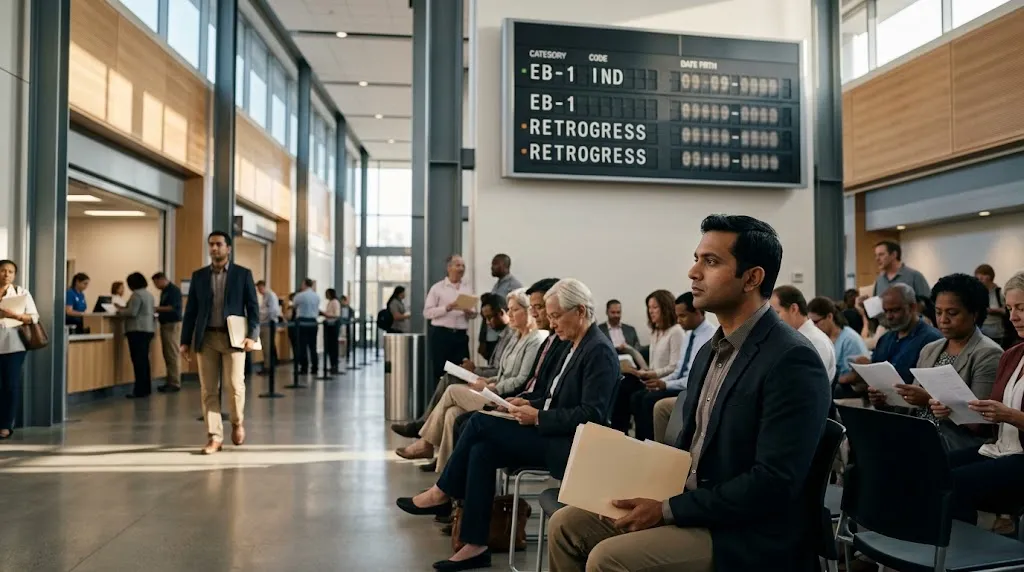
The EB-1 category for India has historically experienced periods of both advancement and retrogression. For many years, EB-1 India was “current,” meaning all qualified applicants could file without waiting. However, a surge in EB-1 petition filings — particularly EB-1C petitions filed by multinational companies transferring executives and managers — contributed to the category becoming backlogged.
Key historical milestones:
- Prior to 2016, EB-1 India was generally current for most of the fiscal year.
- Beginning around 2017–2018, EB-1 India began experiencing retrogression near the end of fiscal years (typically August–September).
- Since 2020, the EB-1 India category has frequently been backlogged throughout the entire fiscal year.
- Occasional advances occur when USCIS receives fewer applications than expected or unused visa numbers from other categories “fall down” to EB-1.
Retrogression risk: Retrogression occurs when the Department of State moves a cutoff date backward because demand exceeds the number of available visa numbers. For EB-1 India, retrogression is a real possibility — especially toward the end of the federal fiscal year in September. If your priority date is close to the cutoff, retrogression could delay your case by months or more.
For example, an applicant’s priority date could be current under one month’s Final Action Dates chart but fall behind the cutoff if the Department of State retrogresses the category the following month. In that situation, final green card approval generally must wait until the priority date becomes current again.
What Affects the EB-1 Priority Date for India?
The primary reason for the EB-1 India backlog is the per-country limit established by the Immigration and Nationality Act (INA). Under current law, no single country can receive more than approximately 7% of the total employment-based green cards available in a given fiscal year. Because the number of qualified Indian nationals far exceeds this cap, a significant backlog has developed.
There are approximately 140,000 employment-based green cards available each fiscal year (plus any unused family-based numbers). With the 7% cap, India can receive roughly 9,800 employment-based green cards per year across all EB categories — a number far below the demand.
Legislative efforts: Various bills have been introduced in Congress over the years to eliminate or raise per-country caps for employment-based green cards. While some have passed one chamber, none have been signed into law as of this writing. If such legislation were to pass, it could significantly reduce wait times for Indian nationals.
Cross-Chargeability: A Potential Strategy
One potential option for some Indian nationals is cross-chargeability. Under this rule, a visa applicant may be “charged” to the country of birth of their spouse rather than their own country of birth. If your spouse was born in a country with current or shorter EB-1 wait times (such as the United Kingdom, Canada, or many European countries), you may be able to use their country of chargeability to obtain a visa number sooner.
Cross-chargeability is not automatic — it must be requested and properly documented. An experienced immigration attorney can help you determine if this option applies to your situation.
EB-1A vs. EB-1B vs. EB-1C for Indian Nationals
The EB-1 preference category has three subcategories, each with distinct requirements. All three share the same priority date cutoff for Indian nationals, but the path to approval differs significantly.
| Feature | EB-1A: Extraordinary Ability | EB-1B: Outstanding Researcher | EB-1C: Multinational Manager |
| Who Qualifies | Individuals with extraordinary ability in sciences, arts, education, business, or athletics | Outstanding professors and researchers with international recognition | Multinational executives and managers transferring to a U.S. office |
| Employer Required? | No — self-petition allowed | Yes — employer must sponsor | Yes — employer must sponsor |
| Labor Certification | Not required | Not required | Not required |
| Key Evidence | Meet 3 of 10 USCIS criteria demonstrating sustained acclaim | 2+ years of recognized research; international recognition in the field | 1+ year of employment abroad in managerial/executive role within the past 3 years |
| Job Offer Required? | No | Yes — permanent research position | Yes — managerial/executive position in the U.S. |
| Advantage | Self-petition flexibility; no employer dependency | Lower burden than EB-1A; strong for academics | Common route for corporate transfers |
For Indian nationals, the EB-1A subcategory offers a unique advantage: the ability to self-petition without an employer sponsor. This means you maintain greater control over your immigration process and are not dependent on an employer’s willingness to sponsor your case.
Strategies While Waiting for Your Priority Date
Waiting for your EB-1 India priority date to become current can be frustrating, but there are proactive steps you can take during this period:
- File your I-485 when eligible: If USCIS permits employment-based applicants to use the Dates for Filing chart and your priority date qualifies, you can file Form I-485 if you otherwise meet the adjustment-of-status requirements. A pending I-485 can also allow eligible applicants to seek employment authorization and advance parole while the adjustment application remains pending. Filing the application does not itself grant permanent residence; final approval still depends on visa availability and continued eligibility.
- Maintain your nonimmigrant status: Continue to comply with the terms of your H-1B, L-1, or other nonimmigrant visa while waiting. Ensure timely extensions are filed.
- Keep your I-140 valid: If you change employers, understand the rules about I-140 portability. An approved I-140 can retain your priority date even if you move to a new employer, as long as it has been approved for at least 180 days or was not revoked due to fraud or willful misrepresentation.
- Explore cross-chargeability: If your spouse was born in a country with a more favorable priority date, consult an attorney about cross-chargeability options.
- Monitor the visa bulletin monthly: Priority dates can change every month. Stay informed by checking the visa bulletin on the Department of State website and following trusted immigration news sources.
- Consider concurrent EB-1A filing: If you are currently in the EB-1B or EB-1C track, you may also qualify for EB-1A. Filing a separate EB-1A self-petition does not interfere with your existing petition and may provide an alternative path.
- Update your documentation: Use the waiting period to gather additional evidence of your accomplishments — awards, publications, citations, media coverage — that may strengthen your case.
Consular Processing for EB-1 Applicants Outside the United States
Applicants who are abroad when their priority date becomes current do not file an adjustment of status application. They go through consular processing instead, and the mechanics are different in ways that matter for planning.
How the Path Differs
- After the I-140 is approved, the case is forwarded to the National Visa Center rather than to a USCIS field office.
- The applicant pays the required fees and submits civil documents and an immigrant visa application through the NVC’s online system.
- Once the case is documentarily complete and a visa number is available, the NVC schedules an interview at the appropriate U.S. embassy or consulate.
- The applicant attends a medical examination with an approved panel physician before the interview.
- If approved, the applicant receives an immigrant visa and becomes a permanent resident on admission to the United States.
Practical Trade-offs
Consular processing often moves more predictably than adjustment of status, and there is no need to maintain nonimmigrant status in the U.S. while waiting. The trade-off is that consular applicants do not receive interim benefits such as work authorization or advance parole, and a refusal abroad is harder to challenge than a denial inside the United States.
Applicants who are in the U.S. but considering a move abroad, or who are weighing which path to elect, should get advice before making the choice. Switching between paths mid-process is possible in some circumstances but rarely simple.
Steps to Take If Your Form I-485 Is Denied
A denial of your Form I-485 can feel discouraging, but it’s important not to panic. Instead, consider these next steps to protect your immigration prospects:
- Request a copy of the decision notice: Carefully review the denial letter from USCIS. This notice will outline the reasons for denial and inform you if you have the right to appeal or file a motion to reopen or reconsider.
- Act promptly: There are strict deadlines for appeals or motions (often 30 days), so time is of the essence.
- Gather your documentation: Organize all application materials, supporting documents, and any new evidence that addresses the issues raised by USCIS.
- Consult with an experienced immigration attorney: An attorney can assess your specific situation, explain all available avenues—such as filing a motion to reopen, a motion to reconsider, or pursuing a new application—and develop a strategy based on your unique circumstances.
- Consider alternative options: Depending on the reason for denial and your overall status, you may have options like reapplying, seeking relief through another visa category, or considering consular processing.
- Stay informed: Utilize credible resources, such as the American Immigration Lawyers Association https://www.aila.org/ or the Immigrant Legal Resource Center https://www.ilrc.org/, to understand your rights and latest developments that may affect your case.
Taking prompt, informed action can greatly increase your chances of success, even after a denial.
How Bay Legal, PC Can Help
Navigating the complexities of immigration law can be overwhelming, but you do not have to do it alone. At Bay Legal, PC, our experienced immigration attorneys provide personalized guidance tailored to your unique situation. Whether you are applying for the first time or dealing with a complex case, we are here to help you understand your options and pursue the best possible outcome.
Contact us today to schedule a consultation:
- Phone: (650) 668-8000
- Email: intake@baylegal.com
Frequently Asked Questions
1. What is the current EB-1 priority date for India?
For September 2026, the EB-1 India Final Action Date is October 15, 2022, while the Date for Filing is December 1, 2023. These dates can change from month to month, so applicants should check the latest Visa Bulletin before taking action.
2. Why is EB-1 India backlogged?
The EB-1 India backlog exists primarily due to per-country limits that cap the number of green cards any single country can receive at approximately 7% of the annual total. Because demand from Indian nationals far exceeds this cap, a backlog has developed.
3. Can the EB-1 India priority date move backward?
Yes. This is known as retrogression, and it occurs when the Department of State determines that demand exceeds available visa numbers. Retrogression is more common near the end of the fiscal year in September.
4. What is cross-chargeability?
Cross-chargeability allows you to be charged to your spouse’s country of birth instead of your own. If your spouse was born in a country with a more favorable EB-1 priority date, this could allow you to obtain your green card sooner.
5. Is there a difference in wait times between EB-1A, EB-1B, and EB-1C for India?
The Visa Bulletin does not provide separate EB-1A, EB-1B and EB-1C cutoff dates. Applicants chargeable to India generally use the same EB-1 India cutoff, although petition processing and individual case timelines can differ.
6. Can I file my I-485 before the Final Action Date is current?
You may be able to file your I-485 if USCIS accepts filings based on the Dates for Filing chart and your priority date is current under that chart. However, your green card will not be approved until the Final Action Date reaches your priority date.
7. What happens to my priority date if I change employers?
If your I-140 has been approved for at least 180 days and was not revoked due to fraud, you may retain your priority date even if you change employers. This is known as priority date portability.
8. Will Congress eliminate per-country limits?
Several bills have been proposed to eliminate or raise per-country limits for employment-based green cards, but none have been enacted into law as of this writing. Legislative outcomes are uncertain, so it is best to plan your immigration strategy based on current law.
9. How often should I check the visa bulletin?
The visa bulletin is published monthly, typically around the middle of the preceding month. We recommend checking it every month and setting up email alerts from trusted immigration news sources.
10. Can I travel outside the U.S. while waiting for my EB-1 green card?
If you have a pending I-485, you can travel using advance parole (Form I-131). If you are on an H-1B or L-1 visa with a valid visa stamp, you may also travel on that visa. Consult an attorney before traveling to ensure you do not jeopardize your pending application.
Attorney Advertising. This article is for general informational purposes only and does not constitute legal advice. Each immigration case is unique, and results will depend on the specific facts of your situation. Past results do not guarantee future outcomes. For personalized legal guidance, contact Bay Legal, PC. Principal Office: Jayson Elliott, Esq., Bay Legal, PC, 667 Lytton Ave Suite 3, Palo Alto, CA 94301.