TL;DR — Key Takeaways
- Whether California’s home improvement contract rules apply to building an ADU matters, because those rules cap the down payment, limit advance payments, and give homeowners a right to cancel.
- The Contractors State License Board’s position is that building an ADU on-site at an existing home is already a home improvement under current law.
- A board-sponsored bill to say so expressly, AB 559 (2025–2026), passed the Assembly unanimously but stalled in the Senate and died when it missed the August 31, 2026 deadline.
- The question is most contested for factory-built ADUs, where manufacturers opposed the payment limits.
- A homeowner or contractor is on the safest footing contracting as though the home improvement rules apply.
- Neighbors have limited ability to stop an ADU that meets objective standards, and a defect claim over an owner-commissioned ADU generally falls outside the Right to Repair Act.
Whether building an accessory dwelling unit counts as a home improvement under California law determines whether the state’s home improvement contract protections apply: the cap on down payments, the limits on payments ahead of the work, the required contract terms, and the homeowner’s right to cancel. The Contractors State License Board’s position is that on-site ADU construction at an existing home already qualifies. A 2025 bill the Board sponsored to make that explicit died in 2026 without passing the Senate, so the statute still does not name ADUs, and the answer is least settled for factory-built units.
Bay Legal’s post on residential ADU construction disputes covers the practical risks of ADU projects. This post covers the legal rules that decide many of those disputes.
Why the home improvement label matters

California’s contractor law defines home improvement to include repairing, remodeling, altering, converting, or modernizing residential property, or adding to it, and lists many specific kinds of work. When a project is a home improvement, several protections follow:
A capped down payment. A home improvement contractor may not take a down payment exceeding the lesser of $1,000 or 10 percent of the contract price, as of drafting.
No payment ahead of the work. Progress payments generally may not exceed the value of the work performed and materials delivered.
Required contract terms. The contract must be in writing and include specified terms and notices, including, since January 1, 2026, an email address for cancellation notices.
A right to cancel. Homeowners have a short statutory period to cancel certain contracts after signing.
For a project costing as much as a new ADU, the down payment cap and the ban on paying ahead of the work are the protections that matter most. They are what prevent a homeowner from handing over a large sum before any work is done.
What happened to AB 559
The question became urgent after the Board received a wave of complaints about ADU contractors that took deposits and failed to complete projects. The author reported more than 400 such complaints, and one high-profile ADU company’s license was revoked in 2024 after it collected deposits from hundreds of homeowners before going bankrupt.
The Board sponsored AB 559 (2025–2026) to add ADUs on residentially zoned property expressly to the statutory definition of home improvement, and to increase penalties for advance-payment violations. The Board described it as clarifying existing law rather than changing it.
The bill passed the Assembly unanimously in May 2025 and cleared every Senate committee. On September 3, 2025, it was moved to the Senate inactive file at the request of a senator. It was never taken back up. August 31, 2026 was the last day for either house to pass bills this session, so AB 559 is dead for the 2025–2026 session. Opposition centered on manufacturers of factory-built ADUs, whose payment schedules are tied to off-site production rather than work at the homeowner’s property.
As of September 2026 the Board had not announced whether it would reintroduce the proposal in the session beginning December 2026.
If you are about to sign an ADU contract, or already have one and are being asked for a large payment, the question of which rules apply is worth answering before the money moves. Call Bay Legal at (650) 668-8000 in Northern California or (213) 668-8000 in Southern California.
Where the law stands now
On-site construction. The Board’s position is that building an ADU at an existing home, as an addition or a new structure on the property, is already home improvement work. That position is consistent with a definition that reaches additions to residential property, and it is the Board, not a court, that applies it in licensing enforcement.
Factory-built units. The question is more open where the unit is manufactured off-site and delivered for installation. Manufacturers argued that payment limits designed for on-site work do not fit a product built in a factory. Where a contract combines a factory-built unit with on-site foundation, utility, and installation work, the on-site portion looks like home improvement even if the unit itself is contested.
No published decision. As of September 2026, no published California appellate decision resolves whether ADU construction is a home improvement under the statute.
The practical answer. Contracting as though the home improvement rules apply costs a legitimate contractor very little and protects a homeowner considerably. A contract that keeps the down payment within the cap, ties each payment to completed work, and includes the required notices is defensible whichever way the question is eventually resolved.
What an ADU contract should address
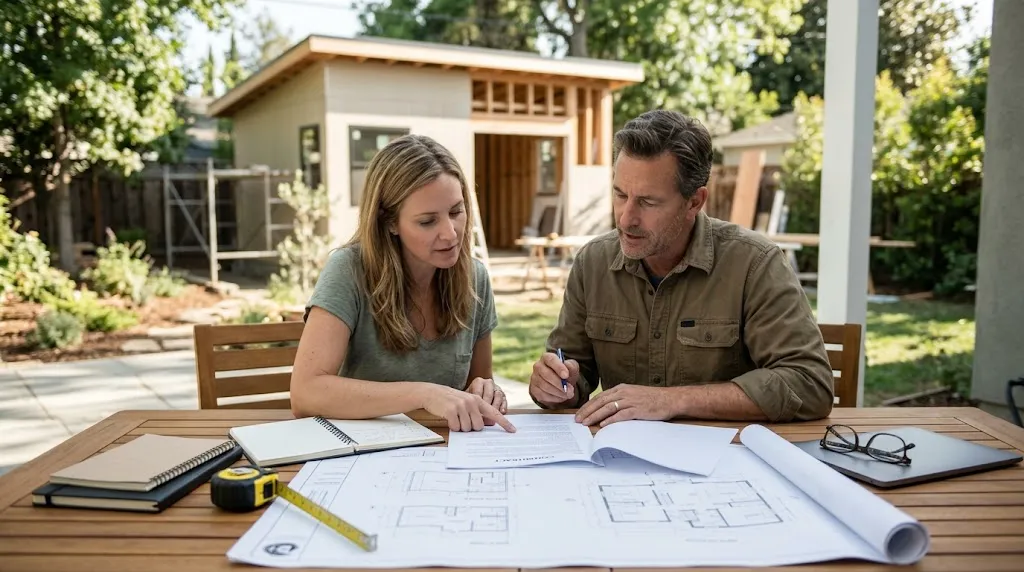
Whichever rules apply, the contract is where most ADU disputes are prevented. The provisions that matter most:
Scope tied to the approved plans, identified by plan set and permit number.
A payment schedule tied to completed milestones, preferably ones confirmed by inspection, rather than to dates.
Permits and utilities: who obtains permits, who coordinates utility connections and fire-access requirements, and who bears the cost and delay if they change.
Change orders: how changes are requested, priced, and approved in writing before the work.
Completion and delay: a completion date and how delays caused by the owner, the agency, or the utility are allocated.
Warranty, license, and insurance: what the contractor warrants, for how long, and verification of licensing, bonding, and coverage before work starts.
Permit conditions become contract terms
ADU approval is ministerial: a local agency approves an application that meets objective standards, without a discretionary hearing. The approved plans and permit conditions define what the owner is allowed to build.
A construction contract to build per approved plans incorporates those conditions, which means a contractor that builds outside them commits both a permit violation and a breach of contract. The consequences land on the owner first, through failed inspections, stop-work orders, and redesign, which is why the contract should allocate responsibility for building to the approved plans explicitly. ADU permit timelines covers the approval process.
Against a contractor that builds outside the plans, an owner’s remedies can include a breach of contract claim, a complaint to the Board, and, if the contractor was unlicensed, recovery of what was paid.
Can a neighbor stop an ADU?
Rarely. Because approval is ministerial, there is generally no discretionary hearing to oppose and no discretionary appeal. A neighbor’s realistic grounds are narrower:
- Objective noncompliance, such as a setback, height, or building code violation, reported to the agency.
- Private restrictions, such as recorded covenants, although an HOA cannot prohibit or unreasonably restrict an ADU on a single-family lot. Can my HOA stop my ADU covers that.
- Property rights, such as an easement or a boundary dispute.
A neighbor’s dislike of the project is not, on its own, a basis for stopping it.
Defect claims on an ADU
An ADU an owner commissions on their own property is generally outside California’s Right to Repair Act, which covers original construction built for sale. Defect claims instead run in breach of contract, breach of warranty, and negligence, subject to the rule that negligence generally requires actual property damage and to a ten-year statute of repose that runs from substantial completion. Does the Right to Repair Act apply to you covers the distinction.
When the dispute is not the contractor’s fault
Worth saying directly.
Many ADU projects run late for reasons no contractor controls: utility connections, fire-access requirements, inspection scheduling, and design changes the owner requested. A homeowner who treats every delay as a breach can turn a recoverable project into a failed one, and a contractor who is blamed for a utility’s schedule has a legitimate grievance. The disputes worth pursuing involve money paid ahead of the work, work outside the approved plans, abandonment, or defective construction. Documenting who caused each delay, as it happens, is what makes the difference later.
Bay Legal advises homeowners and contractors on ADU contracts and disputes. Reach us at (650) 668-8000, (213) 668-8000, or through baylegal.com/contact-us.
Frequently Asked Questions
Is building an ADU a home improvement under California law?
The Contractors State License Board’s position is that building an ADU on-site at an existing home is already a home improvement under current law. The statute does not name ADUs expressly, no published appellate decision has resolved the question, and it is most contested for factory-built units.
What happened to AB 559?
AB 559 (2025–2026), sponsored by the Contractors State License Board, would have added ADUs expressly to the statutory definition of home improvement and increased penalties for advance-payment violations. It passed the Assembly unanimously but was moved to the Senate inactive file in September 2025 and died when it was not passed by the August 31, 2026 deadline.
How much can an ADU contractor require as a down payment?
If the project is a home improvement, the down payment may not exceed the lesser of $1,000 or 10 percent of the contract price, as of drafting, and progress payments generally may not exceed the value of work performed and materials delivered. Contracting within those limits is prudent even where the classification is disputed.
Can a neighbor stop or delay an ADU?
Rarely. ADU approval is ministerial, so there is generally no discretionary hearing or appeal. A neighbor can report objective code or setback violations, rely on private restrictions within the limits the law allows, or assert an easement or boundary claim, but general opposition is not a basis to stop a compliant ADU.
How do defect claims work on an ADU?
An ADU an owner commissions on their own property is generally outside the Right to Repair Act. Defect claims run in breach of contract, breach of warranty, and negligence, which generally requires actual property damage, subject to a ten-year statute of repose that runs from substantial completion.