TL;DR — Key Takeaways
- The question “is my out of state trust valid in california” is usually the wrong question, and the answer to it is usually yes. California recognizes out-of-state documents by statute. Probate Code section 6113 validates a will executed in compliance with the law of the place of execution, or of the place where the testator was domiciled at execution or at death. Section 4053 does the same for a durable power of attorney. Section 4676 does it for an advance health care directive.
- What changes when you move is not the paperwork. It is who owns what. Probate Code section 101 provides that on the death of a married person “domiciled in this state,” one-half of the decedent’s quasi-community property belongs to the surviving spouse. Property earned during marriage in a separate-property state becomes subject to that rule on arrival, and no out-of-state instrument opts out of it.
- There is a clawback almost nobody mentions. Section 102 lets a surviving spouse require a transferee to restore one-half of quasi-community property the decedent gave away without the spouse’s written consent, where the decedent kept the income, kept a power to revoke or invade, or held it with a right of survivorship.
- Quasi-community property has a precise reach. Under section 66 it covers “[a]ll personal property wherever situated, and all real property situated in this state.” Real property outside California is not quasi-community property, which is why a two-state plan needs two answers rather than one.
- Trusts are the one document type with no recognition statute. There is no trust equivalent of section 6113. Section 15400 instead ties California trust law to settlor domicile at creation, execution in California, or a California choice of law – so a valid out-of-state trust usually keeps working, and the question becomes which state’s law now governs it.
The Direct Answer
Usually yes. An out-of-state trust that was valid where it was made generally remains valid, and Probate Code sections 6113, 4053 and 4676 expressly recognize out-of-state wills, powers of attorney and advance directives. The real change on moving is property characterization: quasi-community property under sections 66 and 101 gives a surviving spouse half.
Is My Out of State Trust Valid in California? Start With What the Statutes Recognize
Three of the four documents in a typical estate plan have their own recognition statute. The fourth does not, and that is the interesting one.
A will travels, on three independent grounds. Probate Code section 6113 says a written will is validly executed if its execution complies with any of the following: California’s own formalities in section 6110 or 6111 (or the California statutory will, or the Uniform International Wills Act); “the law at the time of execution of the place where the will is executed”; or the law of the testator’s domicile, place of abode, or nationality, at execution or at death. Only one has to be satisfied. A will properly signed in Illinois is properly signed for California purposes.
California’s own bar is also lower than people expect. Section 6110 wants a writing, a signature, and two witnesses “being present at the same time” who understand that the instrument is a will – and section 6110(c)(2) adds a rescue: a will that fails the witnessing requirement is still treated as compliant if the proponent proves “by clear and convincing evidence that, at the time the testator signed the will, the testator intended the will to constitute the testator’s will.” Section 6111 recognizes a handwritten will “whether or not witnessed.”
A power of attorney travels. Section 4053 is one sentence: a durable power of attorney executed under another state’s law, or California’s, “is valid and enforceable in this state to the same extent” as one executed here, whatever the principal’s domicile.
An advance health care directive travels, and providers may rely on it. Section 4676(a) recognizes “[a] written advance health care directive or similar instrument executed in another state or jurisdiction,” and subdivision (b) provides that “[i]n the absence of knowledge to the contrary, a physician or other health care provider may presume” that such an instrument is valid.
A trust has no equivalent provision, and the absence is the point. There is no section that says “a trust valid where made is valid here.” What California has instead is section 15400, which makes a trust revocable unless expressly made irrevocable and then states its own reach: the section applies only where the settlor was domiciled here when the trust was created, the instrument was executed here, or it provides that California law governs.
In practice a trust that was validly created elsewhere continues to be a valid trust – it is a property arrangement, not a filing. But the governing-law question is live, and it matters because California trust law is not the same as the law the trust was drafted against. This article does not assert which state’s law governs an existing out-of-state trust after a move. That turns on the instrument’s own choice-of-law clause, where the trustee administers, and where the assets sit, and it is a question for counsel on the document in front of them.
One thing does apply regardless. Section 15206 provides that “[a] trust in relation to real property is not valid unless evidenced by” a written instrument signed by the trustee, or a written instrument conveying the trust property signed by the settlor, or by operation of law. A trust document alone does not put a California house into a trust. A deed does.
How Does California Community Property Change an Existing Plan?
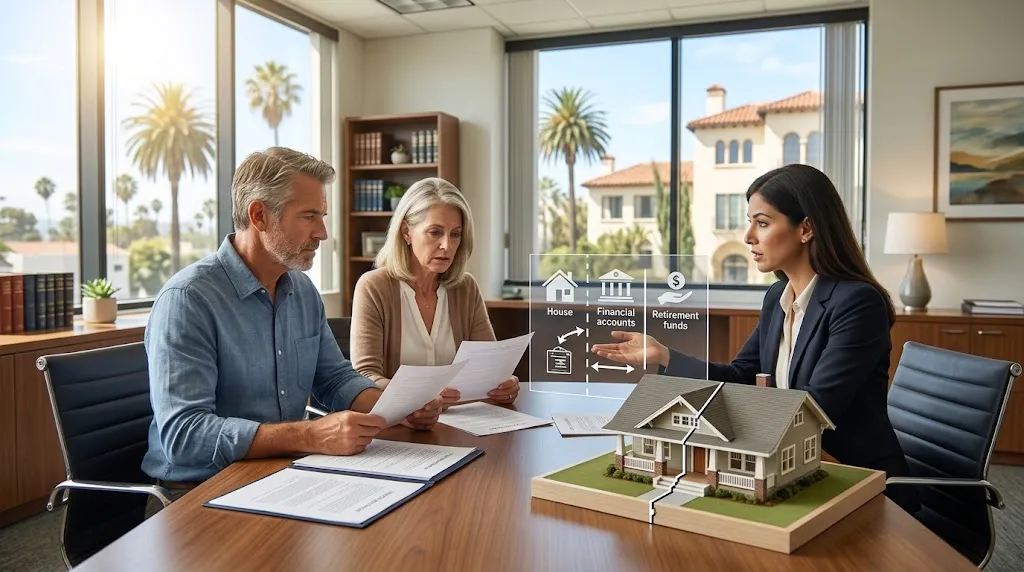
By creating an ownership interest the plan was not drafted around.
If you arrive from Ohio, Illinois, New York or any other separate-property state, everything you earned there was yours. California does not retroactively rewrite that during life. But it changes the answer at death, through a category most arrivals have never heard of.
Probate Code section 66 defines quasi-community property as personal property wherever situated, and California real property, acquired by a decedent while domiciled elsewhere that “would have been the community property” had the decedent been domiciled here when it was acquired, plus property acquired in exchange for such property.
Then section 101(a) does the work: on the death of a married or registered domestic partner domiciled in California, “one-half of the decedent’s quasi-community property belongs to the surviving spouse” and half to the decedent.
Read those together. Salary earned during a thirty-year marriage in Chicago, the brokerage account it funded, the retirement account, the California house bought with it – all of it can be quasi-community property, and the surviving spouse owns half of it at death by statute. A will or trust that leaves everything to children from a first marriage does not change that. It can only dispose of the decedent’s half.
| Community property | Quasi-community property | Separate property | |
|---|---|---|---|
| Where it comes from | Acquired during marriage while domiciled in California | Acquired during marriage while domiciled elsewhere, if it would have been community property here | Gift, inheritance, or pre-marital acquisition |
| What the survivor gets at death | One-half (Sec. 100) | One-half (Sec. 101) | Nothing by operation of these sections |
| Requires California domicile at death? | No | Yes – Sec. 101 says “and is domiciled in this state” | Not applicable |
And there is a clawback. Section 102 lets the surviving spouse require a transferee “to restore to the decedent’s estate one-half of the property” – or its proceeds, or its value at the time of transfer – where the decedent died domiciled in California, made the transfer to someone other than the spouse “without receiving in exchange a consideration of substantial value and without the written consent or joinder of the surviving spouse,” and the transfer was one in which the decedent retained possession, enjoyment or income; retained a power “to revoke or to consume, invade, or dispose of the principal for the decedent’s own benefit”; or held the property with another with a right of survivorship. Life insurance, accident insurance, joint annuities and pensions payable to someone other than the spouse are excluded.
That reaches a lot of ordinary planning: a transfer into an irrevocable trust the decedent kept an interest in, or a joint account set up with a child. So a community property estate plan california couples arrive with has to be looked at in both directions – what the documents say, and what the statute gives the survivor whatever they say.
One provision cuts the other way and is worth knowing. Section 104.5 provides that a transfer of community or quasi-community property to a revocable trust “shall be presumed to be an agreement … that those assets retain their character in the aggregate,” and it applies to transfers before, on or after January 1, 2000. Funding a joint revocable trust does not, by presumption, scramble the characterization.
Which Documents Almost Always Need to Be Redone After a Move?
Not the ones people assume. The health care and property documents, for practical reasons rather than validity reasons.
Almost always redone:
- The advance health care directive. Section 4676 makes an out-of-state form legally valid, and California hospitals still work from California forms. A directive nobody at the admitting desk recognizes is valid and useless at the same moment.
- Any deed for California real property. This is not a formality. Under section 15206 a trust of real property must be evidenced by a signed writing, and a house bought after the move, or a house never deeded to the trust, is not in the trust.
- Beneficiary designations. Retirement accounts, life insurance and payable-on-death accounts pass by designation regardless of the trust, and a move is when people notice the old employer, the old bank and the old address.
Usually worth redoing even though it is valid:
- The power of attorney. Section 4053 makes an out-of-state instrument enforceable, but a California bank or title company reading an unfamiliar form will slow down or decline, and the cost of that delay lands during an emergency.
- The trust and the will, where either was drafted for a separate-property state. The document may be valid and still not do what the couple wants once section 101 gives the survivor half.
Often fine as it stands:
- A will executed properly in the prior state, on section 6113’s second or third ground. An out of state will california probate proceeding is not going to fail because the will was signed in Michigan.
And one practical point about wills, since it is the most common worry: California requires two witnesses present at the same time, and a will signed in a state with the same requirement satisfies both. Section 6112 adds that a will “is not invalid because the will is signed by an interested witness,” though a devise to a subscribing witness creates a rebuttable presumption of duress, menace, fraud or undue influence unless two other disinterested witnesses signed.
How Do Out-of-State and California Properties Interact in One Plan?
They separate, and the dividing line is real property.
Real property is governed where it sits. That is the practical consequence of two things read together. Section 66 includes in quasi-community property “all real property situated in this state” – and by its own terms, not real property situated anywhere else. So the Ohio rental house is not quasi-community property no matter how long you live in California.
The mirror-image case has its own statute. Section 120 addresses someone who never moved but owns California real property: where a married person dies domiciled elsewhere leaving a will disposing of California real property that is not community property, the surviving spouse “has the same right to elect” against the will as if the property sat in the decedent’s domicile. California imports the domicile state’s elective share for that property.
So a couple who moved from a separate-property state and kept the old house is running two systems at once: the California assets and all personal property under sections 66 and 101, and the out-of-state real property under whatever that state does. The practical answers follow from that split rather than from any single rule:
- Put out-of-state real property into the trust, or hold it another way that avoids a second probate. A separate proceeding in the property’s state is the usual cost of not doing so.
- Do not assume one trust document covers both. It probably can, but the deed for each parcel is executed and recorded where the parcel is, under that state’s requirements.
- Track which assets are which. Section 66 turns on what the property would have been “if the decedent had been domiciled in this state at the time of its acquisition,” which is a historical question about the source of the money. Records made now are cheaper than reconstruction later.
- Expect the personal property answer to be uniform and the real property answer not to be. Brokerage accounts, retirement accounts and cash follow section 66 wherever they are held.
What Should New California Residents Update First?

In this order, because the first two are the ones that fail fastest.
- The advance health care directive and the HIPAA authorization, on a California form. This is the document most likely to be needed first and most likely to be questioned.
- Deeds for any California real property, including anything bought after the move. Section 15206 means a trust document without a deed leaves the house out.
- Beneficiary designations, which no trust amendment touches.
- A community property review with the trust and will in hand. The question is not whether the documents are valid. It is what section 101 gives the surviving spouse and whether that is what the couple intends. For a second marriage with children on both sides, this is the whole conversation.
- The power of attorney, on a California form, for acceptance rather than validity.
- The trust’s governing law and trustee provisions, if the trust was drafted for another state’s law.
The update estate plan after moving to california list is short, and the order matters more than the length. What it deliberately does not start with is “make a new trust.” A valid trust is an asset-holding arrangement that usually keeps working; the failures cluster in the documents that have to be accepted by a third party, and in the deeds.
When to Bring Counsel In
Within the first year, and before a second marriage’s plan is left alone on the assumption it still works.
The timing matters because two of the statutes turn on domicile at death, not on how long you have been here. Section 101 applies to a decedent who “is domiciled in this state,” and section 102’s clawback applies where “[t]he decedent died domiciled in this state.” There is no waiting period and no grace year. The rules apply from the point California becomes home.
The second-marriage case is the one that goes wrong quietly. A plan drafted in a separate-property state can allocate everything the earning spouse owns to their own children, and that plan was correct where it was written. After the move, section 101 gives the survivor half of the quasi-community property and the plan disposes of the rest. Nobody discovers this until a death, and by then the only available remedies are litigation or a negotiated settlement.
Related reading includes how to avoid ancillary probate on property outside California, ancillary probate for out-of-state owners of California property, why community versus separate property matters for a California plan, how to fund a living trust, and when to update an estate plan.
Work with Bay Legal
Bay Legal, PC advises new California residents on whether an existing will, trust, power of attorney and advance directive still do what they were written to do, on quasi-community property exposure under Probate Code sections 66, 101 and 102, and on deeds for California real property. Call (650) 668-8000 in Northern California or (213) 668-8000 in Southern California, or schedule a consultation at https://baylegal.com/contact-us/.
Frequently Asked Questions
Is my out-of-state will or trust still valid in California?
Almost always. Probate Code section 6113 validates a written will if its execution complied with California law, or with the law of the place of execution, or with the law of the place where the testator was domiciled, had a place of abode, or was a national, either at execution or at death. Only one of the three has to be met. A trust valid where it was created generally continues to be valid, though there is no trust equivalent of section 6113 and the governing-law question is separate. Powers of attorney and advance directives are recognized by sections 4053 and 4676.
How does California community property change an existing plan?
Through quasi-community property. Section 66 defines it as all personal property wherever situated and all California real property acquired while domiciled elsewhere that would have been community property here. Section 101 then gives the surviving spouse one-half of it on the death of a person domiciled in California. A plan leaving everything to children from a prior marriage can only dispose of the decedent’s half. Section 102 adds a clawback for gifts made without the spouse’s written consent where the decedent retained income, a power to invade, or survivorship.
Which documents almost always need to be redone after a move?
The advance health care directive, on a California form, because acceptance matters more than validity. Deeds for any California real property, because under section 15206 a trust of real property needs a signed writing and a trust document alone leaves the house out. And beneficiary designations, which no trust change affects. The power of attorney is valid under section 4053 but usually worth reissuing so a California bank or title company will act on it without delay. A properly executed out-of-state will is generally fine as it is.
How do out-of-state and California properties interact in one plan?
They separate along the real property line. Quasi-community property under section 66 reaches personal property wherever it is held but only California real property, so an out-of-state house is outside that category. Section 120 covers the reverse case: where a person dies domiciled elsewhere owning California real property, the surviving spouse gets the elective share they would have had in the decedent’s domicile. Practically, out-of-state real property should be held so as to avoid a second probate, and each parcel’s deed is executed and recorded under its own state’s rules.
What should new California residents update first?
The advance health care directive and HIPAA authorization on California forms, then deeds for any California real property, then beneficiary designations, then a community property review of the trust and will together, then the power of attorney, then the trust’s governing law and trustee provisions if it was drafted for another state. The order reflects what fails soonest: documents a third party must accept, and deeds. Making a new trust is usually not the first step, because a valid trust generally keeps working.