— Key Takeaways
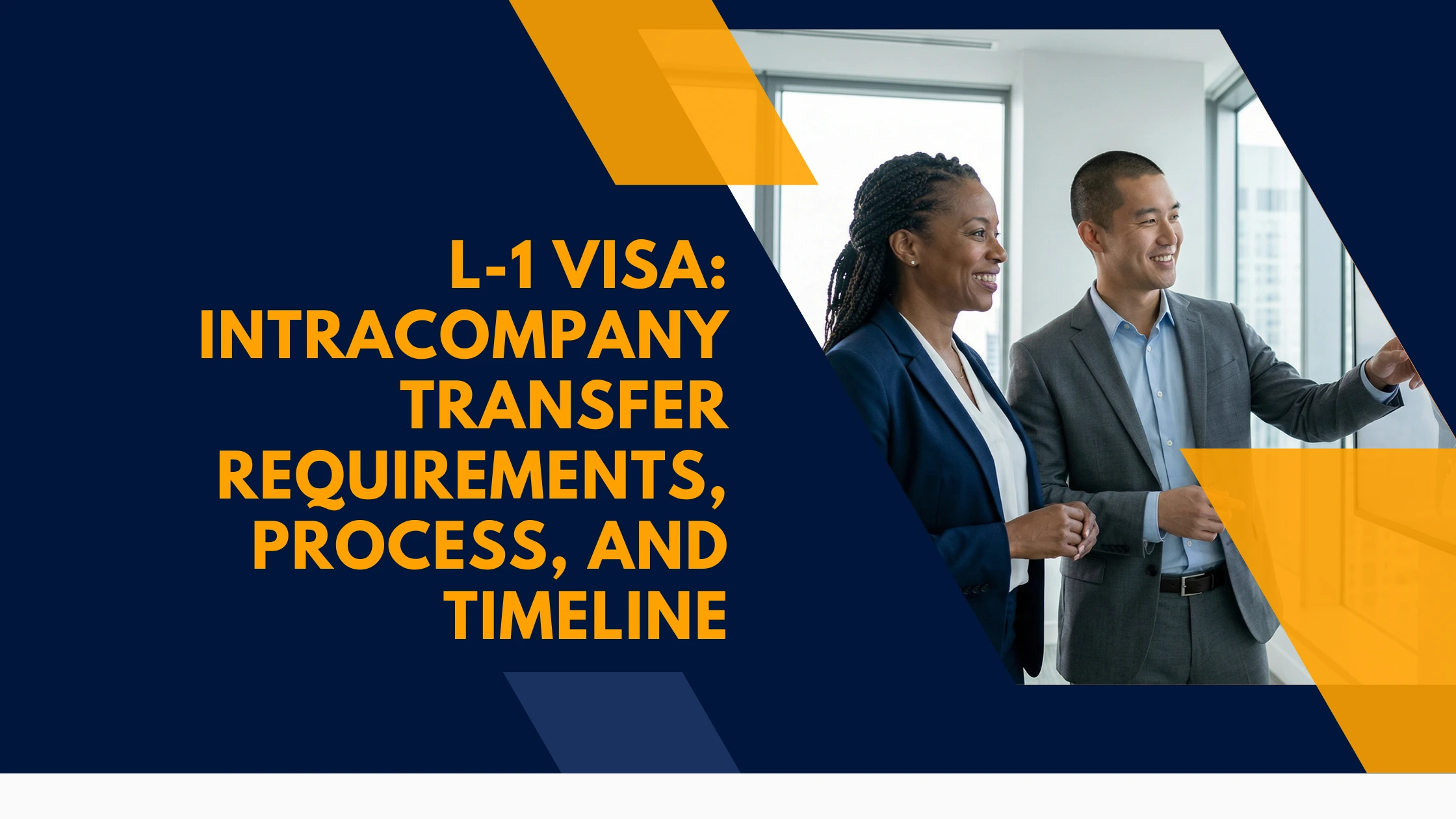
- The L-1 visa allows multinational companies to transfer executives, managers (L-1A), and specialized knowledge workers (L-1B) to the U.S.
- The employee must have worked for a qualifying related company abroad for at least one year within the past three years.
- L-1A holders may stay up to 7 years; L-1B holders may stay up to 5 years.
- The L-1A provides a direct path to an EB-1C green card.
- L-2 dependent visa holders (spouse and children) may be eligible for work authorization.
The L-1 visa is one of the most important nonimmigrant visa categories for multinational companies that need to transfer key employees from foreign offices to the United States. Whether you are a manager, executive, or specialized knowledge worker, the L-1 visa provides a pathway to live and work in the U.S. while continuing your career with your company.
This guide covers everything you need to know about the L-1 visa—the requirements for L-1A and L-1B classifications, the qualifying relationship between companies, the application process, processing times, the L-2 dependent visa, and the L-1 to green card pathway.
What Is the L-1 Visa?
The L-1 visa is a nonimmigrant visa category that allows U.S. employers to transfer certain employees from a qualifying foreign office to a U.S. office. The visa is designed for intracompany transferees and has two subcategories:
- L-1A: For managers and executives
- L-1B: For employees with specialized knowledge
The L-1 visa is employer-sponsored, meaning the U.S. company (or U.S. office of the multinational company) files the petition on behalf of the employee. The visa is particularly popular among technology companies, multinational corporations, and companies expanding into the U.S. market.
L-1A vs. L-1B: Key Differences
While both L-1A and L-1B are for intracompany transferees, there are significant differences:
| Feature | L-1A (Managers/Executives) | L-1B (Specialized Knowledge) |
| Eligible Roles | Managers and executives | Employees with specialized knowledge of the company’s products, services, research, or procedures |
| Maximum Stay | Up to 7 years | Up to 5 years |
| Initial Period | Up to 3 years (1 year for new offices) | Up to 3 years (1 year for new offices) |
| Extensions | 2-year increments up to 7-year max | 2-year increments up to 5-year max |
| Green Card Path | Direct EB-1C pathway (no PERM required) | Typically EB-2 or EB-3 (PERM usually required) |
| Blanket Petition | Available | Available |
L-1A: Managers and Executives
To qualify for L-1A classification, the employee must be coming to the U.S. to serve in a managerial or executive capacity. USCIS defines these terms specifically:
- Manager: Manages an organization, department, or function; supervises and controls the work of other supervisory, professional, or managerial employees; has authority over personnel decisions (hiring, firing, promotion); and exercises discretion over day-to-day operations.
- Executive: Directs the management of the organization or a major component; establishes goals and policies; exercises wide latitude in discretionary decision-making; and receives only general supervision from higher-level executives or a board of directors.
L-1B: Specialized Knowledge
Specialized knowledge refers to knowledge of the company’s products, services, research, equipment, techniques, management, or procedures that is not commonly held in the industry. It can also mean an advanced level of knowledge of the company’s processes and procedures.
USCIS evaluates specialized knowledge on a case-by-case basis. Simply having experience with the company is generally not enough—the employee must possess knowledge that is distinct from what a similarly experienced worker in the industry would have.
Qualifying Relationship Between Companies
For the L-1 visa, the U.S. entity and the foreign entity must have a qualifying relationship. The foreign company must be one of the following in relation to the U.S. company:
- Parent company: The foreign company owns or controls the U.S. entity.
- Subsidiary: The U.S. company is owned or controlled by the foreign company.
- Branch: The U.S. office is a branch of the foreign company.
- Affiliate: Both the U.S. and foreign entities are owned or controlled by the same parent entity or group.
The qualifying relationship must exist at the time of filing and must continue throughout the employee’s L-1 status. USCIS requires documentation to prove this relationship, such as organizational charts, stock ownership records, annual reports, and corporate filings.
One-Year Employment Requirement
The L-1 employee must have been employed by the qualifying foreign company for at least one continuous year within the three years preceding the date of the L-1 application or the date the employee will enter the U.S. in L-1 status.
Key points about this requirement:
- The one year of employment must have been outside the United States
- The employment must have been in a managerial, executive, or specialized knowledge capacity (or any other capacity for the same employer)
- Brief trips to the U.S. during the one-year period generally do not interrupt the continuity of employment
- Time spent in the U.S. in valid status (such as B-1 or H-1B) for the same employer may or may not count, depending on the circumstances
Blanket vs. Individual Petitions
L-1 petitions can be filed as either individual petitions or blanket petitions.
Individual L-1 Petitions
An individual L-1 petition (Form I-129) is filed by the U.S. employer for a specific employee. USCIS adjudicates the petition and, if approved, the employee can apply for the L-1 visa at a U.S. consulate or, if already in the U.S., change status.
Blanket L-1 Petitions
A blanket L-1 petition is available to larger organizations that regularly transfer employees to the U.S. To qualify, the petitioning organization must:
- Be engaged in commercial trade or services
- Have a U.S. office that has been doing business for at least one year
- Have three or more domestic and foreign branches, subsidiaries, or affiliates
- Meet certain additional criteria (such as a minimum number of L-1 approvals, minimum revenue, or minimum number of U.S. employees)
With a blanket petition approval, individual employees can apply for L-1 visas directly at a U.S. consulate without waiting for individual USCIS adjudication—which can significantly speed up the process.
Duration of Stay and Extensions
The maximum duration of L-1 status depends on the subcategory:
- L-1A: Up to 7 years total
- L-1B: Up to 5 years total
Initial admission is typically for up to 3 years. For new offices (companies that have been doing business in the U.S. for less than one year), the initial period is limited to one year.
Extensions are filed in two-year increments using Form I-129. The total time in L-1 status cannot exceed the maximum (7 years for L-1A, 5 years for L-1B). After reaching the maximum, the employee must generally spend at least one year outside the U.S. before being eligible for a new L-1 visa.
Processing Times and Premium Processing
Standard Processing
L-1 processing times (for individual petitions filed with USCIS on Form I-129) vary by service center and fluctuate over time. Current processing times can be checked on the USCIS processing times tool.
Premium Processing
Premium processing (Form I-907) is available for L-1 petitions. When premium processing is filed, USCIS guarantees an initial action within 15 business days. The premium processing fee is in addition to the standard filing fee. Check the USCIS website for the current premium processing fee.
Premium processing does not guarantee approval—it guarantees a faster timeline for USCIS to take an initial action (approval, denial, RFE, or NOID).
Blanket Petition Processing
For employees using an approved blanket petition, there is no separate USCIS adjudication. Instead, the employee schedules a visa interview at a U.S. consulate, where the consular officer evaluates whether the employee qualifies for L-1 classification. This can be faster than individual petition processing.
L-1 to Green Card Pathway
One of the most significant advantages of the L-1A visa is the direct pathway to an employment-based green card through the EB-1C (Multinational Manager or Executive) category.
EB-1C for L-1A Holders
The EB-1C green card category has requirements that closely mirror the L-1A visa:
- The beneficiary must be coming to the U.S. to work in a managerial or executive capacity
- The beneficiary must have been employed abroad by the qualifying entity for at least one year within the three years preceding the petition
- The U.S. employer must have been doing business for at least one year
A key advantage of EB-1C is that no PERM labor certification is required, which eliminates one of the most time-consuming steps in the green card process.
Green Card Options for L-1B Holders
L-1B holders do not have a direct green card category equivalent. They typically pursue green cards through the EB-2 or EB-3 categories, which usually require PERM labor certification. The PERM process involves the employer testing the U.S. labor market to demonstrate that there are no qualified U.S. workers available for the position.
L-2 Dependent Visa and Work Authorization
The L-2 visa is available to the spouse and unmarried children (under 21) of L-1 visa holders.
L-2 Work Authorization
L-2 spouses are eligible to apply for an Employment Authorization Document (EAD), which allows them to work for any employer in the United States. To obtain an EAD, the L-2 spouse must file Form I-765 with USCIS.
Note that USCIS policies regarding L-2 work authorization have evolved over time. As of the most recent guidance, L-2 spouses are eligible for work authorization incident to their L-2 status. Check the USCIS website for the most current information.
L-2 for Children
Unmarried children under 21 of L-1 holders can obtain L-2 status to live and study in the U.S. L-2 children are not eligible for work authorization.
How Bay Legal, PC Can Help
Navigating the immigration process can be complex and stressful. At Bay Legal, PC, we provide personalized guidance to help you understand your options, prepare thorough applications, and respond to any issues that arise during processing. Our experienced immigration attorneys work closely with each client to develop the strongest possible case.
Contact us today to schedule a consultation:
- Phone: (650) 668-8000
- Email: intake@baylegal.com
Frequently Asked Questions
1. What is the L-1 visa?
The L-1 visa is a nonimmigrant visa that allows U.S. employers to transfer executives, managers (L-1A), and specialized knowledge workers (L-1B) from a qualifying foreign office to a U.S. office.
2. What is the difference between L-1A and L-1B?
L-1A is for managers and executives and allows a maximum stay of 7 years with a direct EB-1C green card pathway. L-1B is for specialized knowledge workers, allows a maximum stay of 5 years, and typically requires PERM for a green card.
3. How long do you have to work abroad before qualifying for L-1?
You must have worked for the qualifying foreign company for at least one continuous year within the three years preceding the L-1 application or U.S. entry.
4. Can I change employers on an L-1 visa?
No. The L-1 visa is employer-specific. If you change employers, you would need to obtain a different visa classification or have the new employer file a new L-1 petition (if a qualifying relationship exists).
5. Can my spouse work on an L-2 visa?
Yes. L-2 spouses are eligible to apply for an Employment Authorization Document (EAD), which allows them to work for any U.S. employer.
6. What is a blanket L-1 petition?
A blanket L-1 petition allows qualifying larger organizations to pre-approve the transfer framework so that individual employees can apply for L-1 visas directly at a U.S. consulate without separate USCIS adjudication for each employee.
7. Can L-1 lead to a green card?
Yes. L-1A holders have a direct pathway to the EB-1C green card category (multinational manager/executive), which does not require PERM labor certification. L-1B holders can pursue EB-2 or EB-3 green cards.
8. Is premium processing available for L-1?
Yes. Premium processing (Form I-907) is available for L-1 individual petitions, guaranteeing an initial action within 15 business days.
9. What is specialized knowledge for L-1B?
Specialized knowledge refers to knowledge of the company’s products, services, research, equipment, techniques, management, or procedures that is not commonly held in the industry, or an advanced level of knowledge of the company’s processes.
10. How long can I stay on an L-1 visa?
L-1A holders can stay for a maximum of 7 years. L-1B holders can stay for a maximum of 5 years. After reaching the maximum, you must generally spend at least one year outside the U.S. before being eligible for a new L-1.
Attorney Advertising. This article is for general informational purposes only and does not constitute legal advice. Each immigration case is unique, and results will depend on the specific facts of your situation. Past results do not guarantee future outcomes. For personalized legal guidance, contact Bay Legal, PC. Principal Office: Jayson Elliott, Esq., Bay Legal, PC, 667 Lytton Ave Suite 3, Palo Alto, CA 94301.