— Key Takeaways
- A priority date establishes your place in the green card queue; for PERM cases, it is typically the date your PERM application was filed.
- The EB-2 India priority date backlog is one of the longest in the system, with wait times that can span many years.
- Priority date movement is affected by annual visa limits, per-country caps, demand, and spillover from other categories.
- Strategies while waiting include maintaining H-1B status through extensions, exploring EB-1 or NIW options, and considering an EB-3 downgrade.
- Cross-chargeability — using a spouse’s country of birth — may provide an alternative if your spouse was born in a country with a more favorable visa bulletin. Check the monthly Visa Bulletin for current dates.
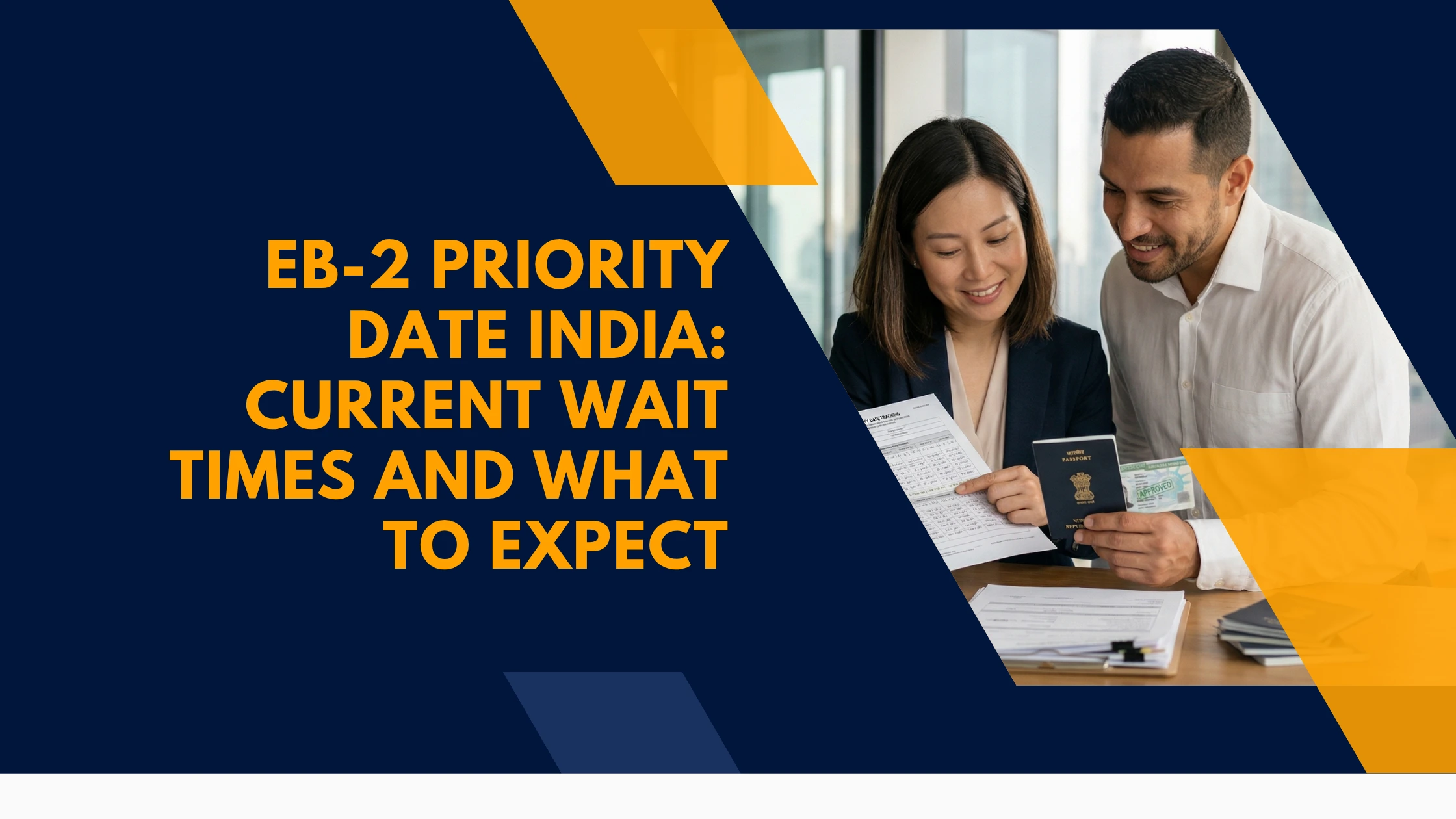
For Indian nationals pursuing employment-based green cards, the EB-2 priority date for India is one of the most closely watched numbers in immigration law. Due to the per-country cap on green card issuance and the extraordinarily high demand from Indian applicants, the EB-2 India backlog has stretched to many years. Understanding what the priority date means, how it moves, and what options are available while you wait is essential for long-term immigration planning.
This guide explains priority dates, the current state of the EB-2 India visa bulletin, historical movement trends, factors that affect advancement, and strategies you can use while waiting in the queue.
What Is a Priority Date?
A priority date is the date that establishes when you entered the green card queue. It determines when you are eligible to complete the final step of the green card process — either filing for adjustment of status (Form I-485, if in the U.S.) or attending an immigrant visa interview at a consulate abroad.
How the priority date is established depends on the filing method:
- PERM-based cases (EB-2 and EB-3): The priority date is typically the date the PERM labor certification application was filed with the Department of Labor.
- EB-2 NIW (self-petition): The priority date is the date the I-140 petition was filed with USCIS.
- EB-1 (no PERM required): The priority date is the I-140 filing date.
The Department of State publishes the monthly Visa Bulletin, which shows the “cutoff dates” for each category and country. If your priority date is earlier than the cutoff date, your date is “current” and you can proceed with the final stage of your green card.
Current EB-2 Priority Date for India
The EB-2 priority date for India fluctuates from month to month based on the Visa Bulletin published by the Department of State. Because the exact cutoff date changes regularly, we strongly encourage you to check the current Visa Bulletin for the most up-to-date information.
General observations as of recent years:
- The EB-2 India backlog has been substantial, with cutoff dates often several years behind the current date.
- Movement has been uneven — some months see significant advancement, while others see retrogression (dates moving backward).
- The backlog is driven by the combination of the per-country cap (no more than 7% of total annual employment-based visas for any single country) and the extremely high volume of Indian applicants.
Important note: We do not publish specific cutoff dates in this article because they change monthly. Always rely on the official Visa Bulletin for current data.
Historical Priority Date Movement
Looking at historical trends can help you understand what to expect, though past movement does not guarantee future results:
- Year-to-year variation: Some fiscal years have seen significant forward movement (dates advancing by months or even years), while others have seen stagnation or retrogression.
- End-of-fiscal-year surges: September (the last month of the federal fiscal year) sometimes sees dramatic forward movement as the State Department tries to use up all available visa numbers before they expire. This can result in dates jumping forward, only to retrogress in October when the new fiscal year begins.
- Spillover effect: When visa numbers go unused in higher preference categories (EB-1) or by other countries, they may “spill over” to EB-2, potentially advancing the India cutoff date. The mechanics of spillover have changed over time and can significantly impact movement.
- Legislative changes: Any legislative reform affecting per-country caps, total visa numbers, or the allocation system could dramatically change the backlog. Several bills have been introduced in Congress to eliminate or raise per-country caps, but none have been enacted as of this writing.
Factors Affecting Priority Date Advancement
Several factors determine how quickly (or slowly) the EB-2 India priority date advances:
- Annual visa limits: Congress sets the total number of employment-based green cards at approximately 140,000 per year (plus any unused family-based visas from the prior year).
- Per-country cap: No single country can receive more than 7% of the total annual employment-based visas. This cap is the primary driver of the India and China backlogs.
- Demand from India: The number of Indian nationals with approved I-140 petitions far exceeds the available visas, creating the substantial backlog.
- Spillover from other categories: Unused visas from EB-1, EB-4, and EB-5 may spill over to EB-2, and unused EB-2 visas may spill over to EB-3, affecting both categories’ movement.
- USCIS and State Department processing: The efficiency of petition adjudication and visa processing can affect how many visas are issued in a given fiscal year.
- Legislative changes: Any reform to the per-country cap or total visa numbers would have the most significant impact. Proposals such as the EAGLE Act and similar bills have aimed to address the India backlog, but none have been enacted.
What You Can Do While Waiting
The extended wait for EB-2 India green cards creates a challenging situation for many applicants. Here are strategies to consider:
Maintain Valid Nonimmigrant Status
Most EB-2 India applicants are on H-1B status. The good news is that once your I-140 is approved, you can extend your H-1B status in three-year increments beyond the standard six-year maximum, under Section 104(c) of the AC21 Act. This allows you to remain in the U.S. and continue working while waiting for your priority date to become current.
Consider an EB-3 Downgrade
As discussed in our EB-2 vs EB-3 guide, downgrading to EB-3 may result in a faster green card if EB-3 India dates are more favorable. You can retain your EB-2 priority date when porting to EB-3.
Explore EB-1 Categories
If you qualify for EB-1A (extraordinary ability) or EB-1B (outstanding professor or researcher), these categories may have more favorable priority dates for India. EB-1 does not require PERM labor certification.
File an EB-2 NIW
Filing a National Interest Waiver provides an additional approved I-140 and may offer strategic advantages, particularly if you want to change employers or become self-employed while maintaining your priority date.
Plan for H-4 EAD
If you have an approved I-140 and are in H-1B status, your H-4 dependent spouse may be eligible for an Employment Authorization Document (EAD), allowing them to work in the United States.
Monitor Legislative Developments
Stay informed about immigration reform legislation that could affect per-country caps and the EB-2 India backlog. While legislation is uncertain, it could dramatically change the timeline.
Cross-Chargeability Options
Cross-chargeability is a provision that allows you to be “charged” to your spouse’s country of birth (instead of your own) for visa number purposes. This can be extremely advantageous if your spouse was born in a country that does not have a significant green card backlog.
For example:
- If you were born in India but your spouse was born in a country where EB-2 is current (such as the UK, Canada, or Brazil), you may be able to use your spouse’s country of chargeability.
- This applies only if your spouse is also applying for a green card (either as a principal applicant or as a derivative beneficiary on your case).
- Cross-chargeability can dramatically reduce or eliminate the wait time.
This is a nuanced area of immigration law, and an experienced attorney can help you determine whether cross-chargeability is available and beneficial in your case.
Concurrent Filing When Dates Are Current
When the EB-2 India priority date advances to the point where your date becomes current (or if USCIS allows concurrent filing), you can file Form I-485 (Adjustment of Status) along with your I-140 petition or after I-140 approval. The benefits of filing I-485 include:
- Employment Authorization Document (EAD): You receive work authorization independent of your H-1B status, giving you more flexibility to change employers.
- Advance Parole: You can travel internationally and re-enter the U.S. without needing a valid H-1B visa stamp.
- Protection under AC21: After your I-485 has been pending for 180 days, you can change employers without jeopardizing your green card application, as long as the new position is in the same or similar occupational classification.
However, if your priority date subsequently retrogresses (moves backward) after you file I-485, your application will remain pending but cannot be adjudicated until your date becomes current again.
How Bay Legal, PC Can Help
Navigating the immigration system can be complex, stressful, and high-stakes. At Bay Legal, PC, we guide individuals, families, and employers through every step of the immigration process with personalized attention and deep subject-matter knowledge. Whether you are applying for an H-1B visa, pursuing a green card, or exploring other immigration options, our team is here to provide strategic counsel tailored to your unique circumstances.
Contact us today to schedule a consultation. Call us at (650) 668-8008 or email intake@baylegal.com to get started.
Frequently Asked Questions
1. What is the current EB-2 priority date for India?
The priority date changes monthly. Check the Department of State’s Visa Bulletin for the most current EB-2 India cutoff date. We recommend checking both the “Final Action Dates” and “Dates for Filing” charts.
2. How long is the EB-2 India wait time?
Wait times for EB-2 India have varied significantly but can span many years from the priority date to green card issuance. The exact wait depends on your individual priority date and the pace of Visa Bulletin movement.
3. Can I switch from EB-2 to EB-3 to get my green card faster?
Yes. This is known as an EB-2 to EB-3 downgrade. If EB-3 India dates are more favorable, you can file a new PERM and I-140 under EB-3 while porting your EB-2 priority date, potentially getting a faster green card.
4. What is cross-chargeability?
Cross-chargeability allows you to use your spouse’s country of birth for visa number purposes. If your spouse was born in a country without a significant backlog, this can dramatically reduce your wait time.
5. Can I extend my H-1B while waiting for my green card?
Yes. Once your I-140 is approved, you can extend your H-1B in three-year increments beyond the normal six-year limit under AC21 Section 104(c), as long as you are waiting for your priority date to become current.
6. What happens if my priority date retrogresses?
If the Visa Bulletin cutoff date moves backward past your priority date, your application is considered “not current” and cannot be processed for final action until the date advances again. If you have a pending I-485, it remains pending but will not be adjudicated.
7. Will Congress eliminate the per-country cap?
Several bills have been proposed to eliminate or raise per-country limits, but none have been enacted. Legislative outcomes are uncertain, and the current per-country cap remains in effect.
8. Can I file I-485 if my priority date is not current?
Generally, no. You must wait until your priority date is current (per the Visa Bulletin) to file I-485. Some periods may allow concurrent filing based on the “Dates for Filing” chart, but USCIS announces monthly whether concurrent filing is permitted.
9. What is the difference between Final Action Dates and Dates for Filing?
The Visa Bulletin has two charts: “Final Action Dates” (when green cards can actually be issued) and “Dates for Filing” (when you may submit your I-485 or immigrant visa application). USCIS announces each month which chart applies for I-485 filing.
10. Should I also file an EB-1 petition?
If you may qualify for EB-1A (extraordinary ability) or EB-1B (outstanding professor/researcher), it is worth exploring. EB-1 often has more favorable priority dates for India and does not require PERM. An attorney can evaluate whether you meet the criteria.
Disclaimer
Attorney Advertising. This article is for general informational purposes only and does not constitute legal advice. Each immigration case is unique, and results will depend on the specific facts of your situation. Past results do not guarantee future outcomes. For personalized legal guidance, contact Bay Legal, PC. Principal Office: Jayson Elliott, Esq., Bay Legal, PC, 667 Lytton Ave Suite 3, Palo Alto, CA 94301.