

Equal Protection Under Law: How MLK’s Legacy Shaped Modern Real Estate, Immigration, and Construction Rights
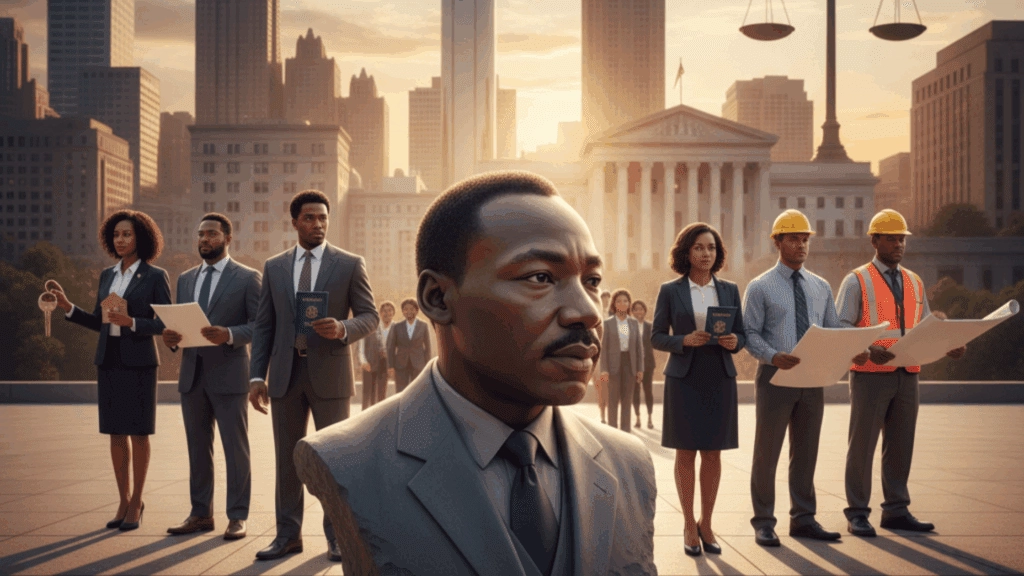
The real estate agent’s lie was simple and efficient. When Black home seekers walked into the office in Chicago’s Gage Park neighborhood during the mid-1960s, the answer came fast: “I’m sorry, we don’t have anything listed.” Then came a subtle shift. When white staff members from Dr. Martin Luther King Jr.’s organization entered those same offices moments later, the books opened. “Oh yes, we have several things. Now what exactly do you want?” This was not happenstance. It was method. It was proof. And it was how Martin Luther King Jr. and the civil rights movement systematized the exposure of a legal crime that no amount of legislation could yet prevent—the deliberate, methodical exclusion of Black Americans from housing based solely on race. Most people know King as the architect of the Civil Rights Movement, the dreamer whose words echoed from the steps of the Lincoln Memorial. Fewer understand that King recognized housing discrimination as something far more sinister than mere social prejudice. It was the financial architecture of racism itself. When Black Americans were systematically barred from building wealth through homeownership, when they were confined to low-income areas with deteriorating housing stock, when entire neighborhoods remained off-limits by law and custom—King understood this wasn’t incidental to racial injustice. It was central to it. The Chicago Campaign That Changed Housing Law From 1965 to 1966, King co-led the Chicago Freedom Movement in one of the most residentially segregated cities in the country. Chicago wasn’t unique in its segregation. It was simply honest about it. Black homeseekers in the city and surrounding suburbs were effectively barred from middle-class, predominantly white neighborhoods. The barriers weren’t theoretical. They were enforced. Real estate agents turned people away. Mortgage lenders rejected applications. White mobs gathered at the borders of neighborhoods to prevent Black families from moving in. King’s strategy in Chicago was precise. His organization coordinated tenant unions. They shared their demands directly with city government leaders. They marched through majority-white neighborhoods, forcing uncomfortable confrontations with segregation in its most visible form. The demand was straightforward: “open housing”—the elementary right for Black Americans to buy homes anywhere they wished. To prove what was happening, King and his allies employed a tactic that would become foundational to civil rights enforcement: testing. The method was straightforward but powerful. Trained testers—pairs of people, one Black and one white, or variations matching different protected characteristics—would conduct the same housing transaction simultaneously. They’d ask the same questions, express the same interest, offer the same qualifications. When discrimination occurred, the difference in treatment became documented, irrefutable evidence. King explained it plainly: “We sent Negroes in large numbers to the real estate offices in Gage Park. Every time Negroes went in, the real estate agent said ‘Oh, I’m sorry we don’t have anything listed.’ And then soon after that we sent some of our fine white staff members into those same real estate offices and the minute those white persons got in, they opened the book.” From Chicago to Federal Law The campaign created friction, anger, and ultimately, results. By August 1966, after approximately a year of relentless organizing despite facing violence from white Chicagoans, the Chicago Freedom Movement achieved concrete victories. The Chicago Housing Authority agreed to build public housing in white middle-class areas. The Mortgage Bankers Association promised to stop discriminatory lending policies. But these local victories, significant as they were, became footnotes to what followed. Two years later, one week after King was assassinated in Memphis, Tennessee, Congress passed the Fair Housing Act. The timing was not coincidental. It was, in some measure, a response to King’s work and his death—an acknowledgment, however incomplete, that housing segregation had become untenable as national policy. The Fair Housing Act made discrimination in housing based on race, color, religion, or national origin illegal. It established procedures for enforcement. It created legal remedies for victims. On paper, it ended an era. In practice, it began another one—the ongoing struggle to actually enforce the law. Today, more than 50 years after King’s assassination and the passage of the Fair Housing Act, housing discrimination persists. It has evolved. It has become more subtle, harder to prove, easier to rationalize. But it has not disappeared. Civil rights organizations like the Equal Rights Center continue to use the testing methods King pioneered to document discrimination. They have uncovered source-of-income discrimination against housing voucher holders. They have found race discrimination against individuals with criminal records. They have exposed housing discrimination against people with disabilities. A Broader Legacy King’s contributions to housing law represent only one dimension of his impact on modern civil rights. His philosophy extended to immigration, labor, and economic justice in ways that remain strikingly relevant today. “Injustice anywhere is a threat to justice everywhere,” King wrote in his 1963 Letter from Birmingham Jail. Those words were not abstractions. They articulated a principle: that discrimination against any group threatened justice for all. Today’s immigrant communities experience this reality acutely. Immigrants arrive seeking work and economic opportunity, yet encounter prejudice, exploitation, and a legal system of breathtaking complexity. Many face unsafe working conditions. Wage theft is common. Housing discrimination follows them. They navigate an immigration system designed, in many respects, to create permanent precarity. King advocated forcefully for economic justice, highlighting labor issues and poverty. Construction workers—both citizens and immigrants—face wage theft, unsafe conditions, and retaliation. In many ways, these struggles echo King’s core argument: that true civil rights must include economic dignity. You cannot have freedom while facing exploitation. You cannot have equality while living in fear of homelessness. You cannot have justice while the legal system treats different categories of people as fundamentally unequal. The Unfinished Work Real estate attorneys today rely on Fair Housing Act protections that King’s movement made possible. Immigration attorneys invoke equal protection principles developed through civil rights litigation. Construction law protections for workers emerged from the broader civil rights framework King helped establish. Yet the fundamental promise remains unfulfilled. Housing segregation continues through different mechanisms—predatory lending, zoning laws that